Aurangzeb reviews economic reforms, trade and investment with World Bank, UK envoy
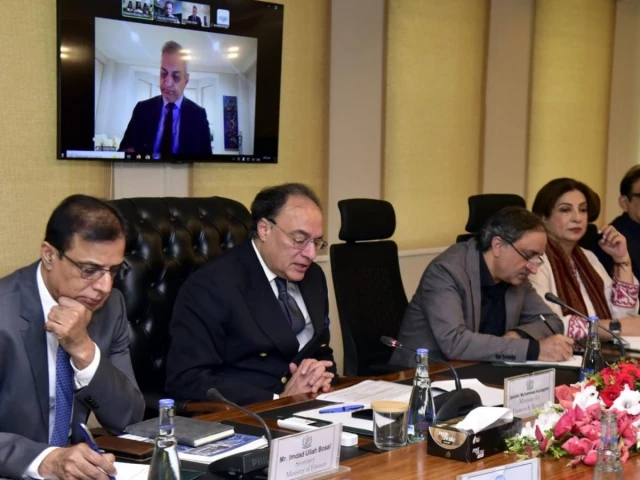
“Finance Minister Muhammad Aurangzeb on Friday stressed the need to move from designing economic reforms to their effective implementation, with a focus on practical measures that could deliver measura…”
Aurangzeb made the remarks during a meeting with a World Bank (WB) delegation led by Country Director Bolormaa Amgaabazar, where the two sides reviewed progress under the ongoing economic reform partnership and discussed implementation priorities covering growth, jobs, fiscal management, revenue mobilisation, capital-market development, trade and investment, and institutional reforms, the finance ministry said in a post on X., the meeting discussed the proposed WB growth and jobs operation, including measures to improve the investment climate, reduce regulatory and business constraints, expand access to finance for small and medium-sized enterprises (SMEs), and develop export-finance products for the Export-Import (EXIM) Bank of Pakistan.
The ministry said the WB had proposed reforms to strengthen the Prime Minister’s Access to Finance initiative, including a unified insolvency framework, factoring legislation and regulations aimed at facilitating SME financing, expanding commercial lending and increasing private-sector participation. Finance Minister, World Bank Review Progress on Economic Reform Partnership, Discuss Implementation Priorities.
Federal Minister for Finance and Revenue, Senator Muhammad Aurangzeb, held a meeting with a World Bank delegation led by Ms. Bolormaa Amgaabazar, Country Director, to…pic.twitter.com/8Mx23v. InWi— Ministry of Finance, Government of Pakistan (@Financegovpk)October 2, 2026Sectoral reforms in pharmaceuticals, medical products and agriculture also came under discussion,.
"Stay connected with Aman-e-Pakistan for ongoing live reporting and verified investigative updates."
The proposed measures included improvements in seed registration, deregulation of selected commodities and stronger international accreditations to help Pakistani businesses participate in international procurement and access global markets, the ministry said.
The two sides also reviewed measures to improve skills development and labour-market alignment, including reforms to the national vocational qualifications framework, greater international recognition of skills and formal overseas migration pathways supported by digital platforms,.
On trade, the meeting reviewed implementation of the National Tariff Policy and analytical support for tariff reforms, including work on the automotive sector and future tariff changes. The discussions focused on competitiveness, productivity, investment, exports and integration into global value chains, the ministry said.
Fiscal and revenue reforms were another key area of discussion., the meeting reviewed the WB’s technical assistance for strengthening tax-policy capacity, including the Medium-Term Revenue Strategy and revenue-policy modelling, alongside GST harmonisation, federal-provincial coordination and improved data sharing. Also Read:PM for export-led economic growth.
Progress on agricultural income tax reforms was also discussed, including implementation of amended provincial laws and rules and the development of digital systems for registration, filing and payment, the ministry said. The meeting stressed the need to improve compliance and strengthen federal-provincial data sharing.
The ministry said provincial property-tax reforms were also discussed, including efforts to improve and harmonise property-valuation approaches, strengthen digital systems and progressively move towards more market-based valuation frameworks. The development of domestic capital markets was discussed in the context of WB Group support for a roadmap through the Capital Markets Development Council,.
The proposed measures seek to deepen domestic capital markets, broaden financing options and strengthen the ecosystem for investment and capital formation. The ministry said the meeting also covered public-sector efficiency and the government’s rightsising agenda, with WB technical assistance focused on improving institutional effectiveness and the efficiency of public resources.
Aurangzeb highlighted the importance of strengthening debt-management capacity and domestic bond markets,. Discussions covered ongoing technical cooperation on financial instruments for managing market risks, domestic bond-market development and improving investor-relations capacity. The WB also briefed the minister on its analytical work on Pakistan’s sovereign credit profile and its pathway towards rating improvement, the ministry said.
Read more:Moody’s upgrade Pakistan to highly speculative B3 rating. In response, Aurangzeb said the government would work to strengthen the quantitative and qualitative drivers of sovereign ratings, including fiscal and debt sustainability, external buffers, sustainable growth, institutional effectiveness and continued structural reforms.
He also stressed the importance of continued engagement with relevant stakeholders to support further improvement in Pakistan’s sovereign credit standing,. The delegation also discussed governance and institutional effectiveness, with emphasis on practical and measurable reforms to improve governance, regulatory quality, transparency, accountability and the broader business environment, the ministry said.
The WB delegation included Operations Manager Lasse Melgaard, IFC Division Director Simon Andrews, Economist Anna Godfriedovna Okutu Twum, Senior Public Sector Specialist Irum Touqeer, IFC Country Officer Sahar Etezaz, Practice Manager Shabih Ali Mohib, Lead Economist Tobias Akhtar Haque, Senior Economist Rafay Khan and Operations Analyst Omar Riaz.
The meeting was also attended by the secretary and senior officials of the Finance Division,. Meeting with British high commissioner.
Later in the day, British High Commissioner to Pakistan Jane Marriott called on Aurangzeb to discuss Pakistan’s economic reform priorities and opportunities for deeper bilateral trade and investment cooperation, the Ministry of Finance on X.It stated that Aurangzeb appreciated the UK’s continued support for Pakistan’s reform efforts through technical assistance, expertise and knowledge sharing.
“Pakistan has moved from stabilisation towards sustainable, inclusive and responsible growth, with greater emphasis on productivity, investment, exports and employment,” he said.
Marriott, who was accompanied by Development Director Sam Waldock and Senior Economist Louie Dane, said the UK remained interested in supporting Pakistan’s economic transformation through technical assistance aimed at strengthening the institutional and policy framework for investment, trade and private-sector development, the ministry said.
She also welcomed Pakistan’s recent issuance of a $3 billion dual-tranche sovereign Eurobond, describing it as significant for investor confidence and access to international capital markets,.
Aurangzeb outlined the government’s six priorities: bringing permanence to macroeconomic stability; moving from stabilisation to sustainable, inclusive and responsible growth; staying the course on structural reforms; moving from aid to trade and investment; expanding access to finance; and positioning Pakistan for the New Economy, the ministry said. Finance Minister, British High Commissioner Discuss Economic Reforms, Trade and Investment CooperationH.E.
Ms. Jane Marriott CMG OBE, British High Commissioner to Pakistan, called on Federal Minister for Finance and Revenue, Senator Muhammad Aurangzeb, to discuss Pakistan’s…pic.twitter.com/oRXGo. RyAEm— Ministry of Finance, Government of Pakistan (@Financegovpk)October 2, 2026The discussions covered fiscal management, tax administration, digitalisation, expenditure efficiency, trade and investment promotion, public investment and public-private partnerships (PPPs),.
Aurangzeb emphasised the importance of coordination among institutions to ensure consistency in implementation and create a more predictable environment for businesses and investors, the ministry said. The ministry further said the discussion covered regulatory reforms and measures to improve the investment environment, including investor facilitation and aftercare, effective investment-promotion mechanisms and the efficiency of key regulatory institutions.
Aurangzeb also highlighted the government’s ongoing efforts to improve the business environment and facilitate domestic and foreign investment,. The two sides discussed PPPs as a means of mobilising private capital for development projects. Aurangzeb underscored the need for stronger project preparation, commercially sound structures and greater institutional capacity to support PPP transactions, the ministry said.
“The British side expressed interest in supporting these efforts through relevant technical expertise, including at the provincial level,” it added. Also Read:PM Shehbaz underscores Pakistan’s potential for high-yield foreign investment.
According to the ministry, Aurangzeb also outlined progress in macroeconomic stability, capital markets and the government’s privatisation efforts, saying the reforms were intended to create greater space for domestic and international investment and move the economy towards investment-led and export-oriented growth.
The meeting also explored ways to strengthen bilateral trade and investment and encourage greater participation by British businesses in Pakistan, it said. Marriott highlighted the potential role of UK companies and diaspora networks in supporting private-sector development, particularly the growth and internationalisation of SMEs,.
Opportunities in the aviation sector were also discussed, including potential international financing and investment.
“The British side highlighted the potential role of international financing partners,” the ministry said, adding that Aurangzeb said relevant technical and commercial considerations would guide the process., Aurangzeb also briefed the British delegation on Pakistan’s external financing strategy, including efforts to strengthen access to international capital markets, improve the quality and sustainability of financing, reduce refinancing pressures and secure longer-term and more competitive sources of capital.
The meeting concluded with both sides reaffirming their commitment to continued Pakistan-UK cooperation on economic reforms, institutional strengthening, trade and investment, with a focus on sustainable growth and expanding opportunities for private-sector engagement, the statement concluded.
Continue Reading: More in Business
Swipe or click arrows to explore Business desk coverage