Haris Waheed speaks about feminine energy and embracing grey characters
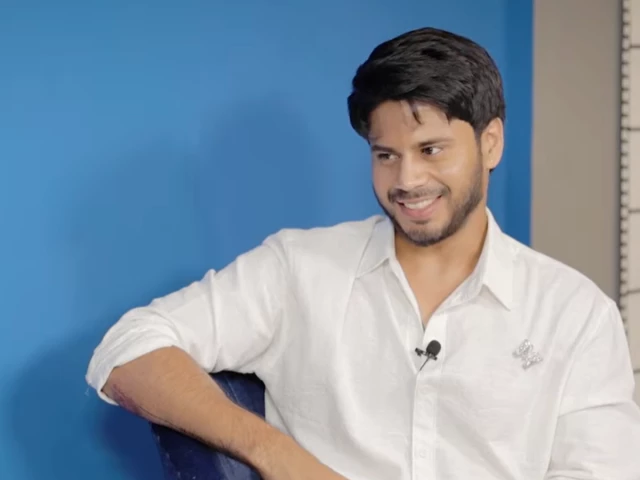
“Actor Haris Waheed got candid in a recent interview withFUCHSIA Magazine, offering a rare, unguarded look at how he approaches identity, performance and the industry he works in. Early in the conversat…”
Early in the conversation, Waheed was asked how he recognised the feminine side of his personality. Rather than defining it through labels, he spoke about the way women around him responded to him and the relationships he shared with them.
“When I see how women are comfortable around me, or how they feel, or what their feedback is when they interact with me, that's where I see a glimpse of my feminine energy,” he said. For Waheed, that sense of feminine energy was also tied to the women who had raised and shaped him.
He pointed to his family as an example, describing the exchanges he shared with his sisters-in-law. He recalled gifting one of them skincare products, while the butterfly accessory he wore during the interview had been given to him by her.
"Stay connected with Aman-e-Pakistan for ongoing live reporting and verified investigative updates."
“We do exchange things within families. So this is a part of my feminine energy,” he said, describing it as a natural extension of the reciprocal and respectful relationships he maintained with the women in his life.
The conversation then moved to his approach to acting, particularly his experience of playing Shayan in. Bas Tera Saath Ho. Waheed acknowledged that the character initially offered him little room to work with on paper.
“Shayan's character on the script was also a by-product of everything else happening in the story, a filling point, really. He had no margin, I felt, on paper,” he said.
He credited director Qasim and the rest of the team with giving him the freedom to develop Shayan beyond what was initially written, eventually turning the role into one he found himself enjoying. Much of that process involved relying on physical details and instinct rather than limiting himself to the script.
Recalling one scene opposite Farhan Tahir,“The material felt flat as written, so I suggested adding a physical beat on the spot, having Shayan stumble and fall to convey the pressure building inside him because I felt the moment needed something the dialogue wasn't giving it,” he said.
For Waheed, that instinct was part of a broader approach to creating realistic characters — allowing them to exist in contradictions rather than forcing them into straightforward categories.
“Rather than playing Shayan as a straightforward villain, I leaned into his grey areas, reacting to my co-stars and the moment rather than over-preparing, so the performance would feel lived-in instead of scripted,” he said. His approach to acting, he explained, was ultimately driven more by personal conviction than external validation.
He said he did not act for praise and had learnt to view criticism as part of an inherently subjective art form rather than something to take personally. That philosophy also informed his views on whether Pakistani dramas could accommodate morally ambiguous protagonists.
Waheed was unequivocal in his response. “Can our dramas show grey heroes? Yes, grey, purple, white, blue, everything.
The audience will accept it as long as they are entertained,” he said. He suggested that audiences were increasingly receptive to characters who moved beyond familiar tropes, arguing that dramas were simply catching up with real life, where people rarely fit neatly into categories of good or bad.
Waheed was similarly positive about the newer generation of actors entering the industry. He described them as more prepared and genuinely interested in experimenting with approaches that differed from what had come before. The actor also offered a glimpse of his upcoming project, tentatively titled.
Lagan Lagi. Produced by Three S Productions and directed by Bilawal Abbasi, the show stars Hina Chaudhry, Saad Khan and Ayesha Toor. Despite its long-series format, he said the team had approached the project with the pace and intensity of a prime-time drama rather than a conventional long-running serial.
For Waheed, the project also offered an opportunity to move away from the style associated with some of his recent work. “I intend to offer something different, hoping people don't get the 'previous work' style from me,” he said, signalling a deliberate shift as he stepped into the new role.
Continue Reading: More in Business
Swipe or click arrows to explore Business desk coverage