'Serious and good scripts are simply not being offered': Hina Dilpazeer on TV's 'lobby system'
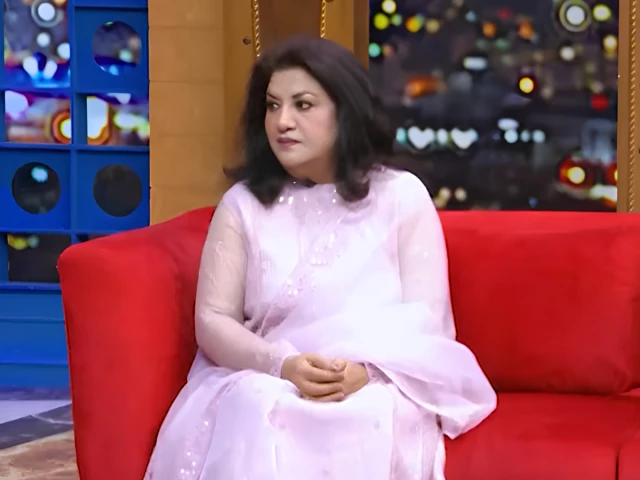
“Veteran actor Hina Dilpazeer, best known for her long-running role as Momo in. Bulbulay, has sharedin a recent interviewwhy she rarely receives serious or varied scripts. Speaking about why she is not ca…”
Speaking about why she is not cast in more diverse roles despite being one of the industry’s most recognisable faces, Dilpazeer pointed to typecasting and what she described as a strong “lobby system” operating within television channels. “Serious and good scripts are simply not being offered right now.
I'm looking for the reasons behind it, but I haven't found them yet,” she said. She was particularly blunt about casting decisions for festival programming, arguing that the same small circle of actors is repeatedly favoured by channels.
“I think the lobby system is very strong. Every channel has five to seven preferred people who wear white sherwanis for Eidul Fitr programmes and black sherwanis for Eidul Adha programmes,” she said, describing what she sees as a pattern of repeated casting regardless of the occasion.
"Stay connected with Aman-e-Pakistan for ongoing live reporting and verified investigative updates."
Still, Dilpazeer has not given up hope that the industry could eventually change. “So, whenever a better time comes, and work is assigned purely on a merit basis, perhaps I will be considered for different kinds of roles as well,” she said.
Rather than dwell on the frustration, however, Dilpazeer said the lack of suitable offers has also given her greater control over the work she accepts. “Looking at it now, I feel it has been a blessing in disguise.
If that continuous cycle was still going on, I would have had to work on very poor scripts. Now I have a choice; I can choose not to do them. If a genuinely good script comes along, I will definitely do it, regardless of the channel,” she said.
Remembering the PTV era. Dilpazeer also reflected on the Pakistan Television era, recalling a time when professional discipline, formal training and mentorship played a greater role in shaping performers.
“Back when PTV was thriving, we had educated people with vast exposure and formal training who used to guide and train newcomers,” she said, adding that the foundation ofadab(etiquette), language and technical knowledge instilled by that generation is largely missing from the current landscape.
She also questioned how much editorial oversight exists on television today, linking what she sees as declining standards to the loss of that professional foundation. “You can clearly see the difference in whose company someone has kept and who has influenced them.
That etiquette, knowledge, and training are essential to learn,” she said. Dilpazeer offered a particularly colourful assessment of the state of PTV today. “PTV is technically still alive, but it's in a coma; it's running only as long as the plug stays connected,” she said.
Language, social media and the importance of writing. Away from television’s broader shortcomings, Dilpazeer said she has little interest in keeping up with social media herself. “I use my phone like an old-fashioned transistor radio: I turn on a song or a podcast, set it aside, and walk away.
I don't sit around scrolling through feeds; I don't have that kind of time,” she said. She was equally direct about the use of language in television dramas, arguing that actors should take responsibility for developing their craft rather than looking for shortcuts.
“If you are performing in an Urdu drama, and you say, 'My Urdu is weak, please write my script in Roman English,' then what kind of acting are you going to pull off?” she said. For Dilpazeer, strong writing remains fundamental to any successful production.
“The script is your absolute backbone. If the script isn't strong, neither you, nor I, nor host Mohsin here can pull a rabbit out of a hat,” she said. She contrasted contemporary television writing with the work of an earlier generation of writers, whom she considers more distinctive in both style and substance.
“Those writers were rich in depth; if you pick up old books or plays, every writer had a distinct style, a unique mindset, and an original concept. Earlier, scripts were written around ideologies; now, they are written around mere behavioural traits,” she said.
Dilpazeer also criticised what she described as pressure on actors to sign projects based on popularity rather than the strength of their scripts. “Channels tell actors, 'Just sign the drama because you are popular, and we will make it a hit.
' But eventually, when people claim an event or project is packed, you look closely, and the field is empty of substance,” she said. The making of Momo. Turning to the role that remains closest to audiences, Dilpazeer credited the creation of Momo in.
Bulbulayto the collective effort of the cast and crew rather than to herself alone. “It was a combined effort; everyone on set helped out. The final result was a product of everyone's creative collusion,” she said.
She also credited the senior actors she watched while developing her own craft, singling out the late Rumana ji and her work in. Naseeb Clinic. “The seniors we learned from were those legendary actors.
Rumana ji had a play called. Naseeb Clinic, and her acting was so effortless and spontaneous. Even today, I watch those old plays to learn something from the seniors,” she said.
What began as a single-episode appearance eventually became an 18-year run, something Dilpazeer said she never anticipated and instead grew into naturally over time. A chance beginning. Looking back on the start of her career, Dilpazeer recalled an unexpected opportunity that changed the course of her professional life.
She had gone to the set of another project when she was asked to step in for an actor who had failed to appear for the play. Bubul. “I went to a set for another project, and there was a play titled.
Bubul. A maid's character was needed because the original actress didn't show up. They asked me, 'Can you do this?
' I asked what I needed to do, and they said, 'Just open the door and ask if the child was found,'” she recalled. With no time to prepare, Dilpazeer improvised, drawing inspiration from a Bengali woman who had worked at her family home.
“I happened to be wearing a saree, and I thought, 'Which maid wears a saree to work? ' Then I recalled a Bengali woman who used to work at our house. So I adopted her accent, opened the door, and delivered the line in that specific tone,” she said.
The impromptu performance caught the attention of writer Fasi Bari Khan and led to the next chapter of her career. “Fasi Bari Khan was the writer of that play. Right after seeing that performance, he said, 'I need her for my next project,' which eventually led to.
Burns Road Ki Nilofer,” she said.
Continue Reading: More in Business
Swipe or click arrows to explore Business desk coverage