Canada's top court upholds Quebec law banning religious symbols in test of unity
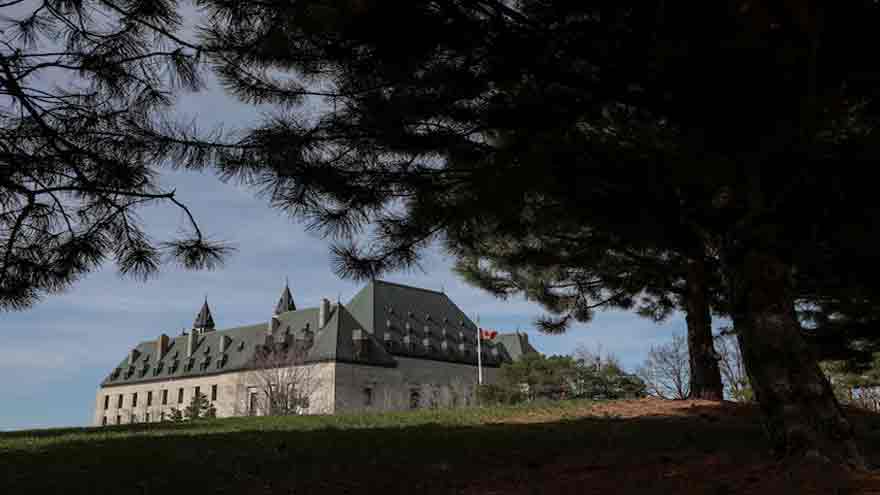
“Canada's Supreme Court on Friday upheld Quebec's ban on religious symbols for public servants, prompting rights groups to warn the ruling unfairly targets Muslim women and weakens legal protections …”
The decision is a political win for Quebec's sovereigntist government and could complicate Prime Minister Mark Carney's efforts to unify Canada as the country faces a trade war and annexation threats from US President Donald Trump. Quebec's previous government passed Bill 21 in 2019, saying it was necessary to protect its secularist society.
Under the law, anyone receiving services from public servants like teachers and police officers in the predominantly French-speaking province has the right to do so without being exposed to overt religious symbols, including hijabs, turbans and yarmulkes. Quebec used an unusual constitutional provision to shield the law from court challenges, which the Supreme Court decided was allowed.
In its ruling, Canada's top court confirmed the validity of Bill 21, saying it is "rooted in Quebec's legitimate and historical commitment to ensuring the laicity of the state in a free and democratic society.
"Stay connected with Aman-e-Pakistan for ongoing live reporting and verified investigative updates."
"The Supreme Court found, however, that one provision of the bill infringed the rights of members of Quebec's National Assembly whose religious beliefs require them to wear a face covering. The ruling drew condemnation from some groups.
"This decision is an unrestricted license for every government in this country to pass legislation taking away the fundamental freedoms and the legal rights of every Canadian," said Stephen Brown, CEO of the National Council of Canadian Muslims.
He said the law had forced many Muslim women - who wear a head covering as part of their faith - to stop working as teachers and that some could no longer be volunteers at their children's schools. Emmett Macfarlane, head of political science at the University of Waterloo, described the law as "Islamophobia as a state policy.
"Quebec is Canada’s only majority-French speaking province and has numerous laws guaranteeing the primacy of the French language and Carney has repeatedly said protecting Quebecois culture is a matter of Canadian sovereignty. Quebec's bill aligns with the French tradition of state secularism, although Quebec’s rules are much narrower than those in France.
“Unlike the rest of Canada, where there is a greater acceptance of all expressions of religious belief, here in Quebec, we have a certain mistrust about the right to express religion, mostly because they are a reminder of a time when religion was extremely influential in political institutions,” said Patrick Taillon, a professor of constitutional law at Laval University in Quebec City.
VICTORY FOR QUEBECKerri Froc, an associate professor at the University of New Brunswick who focuses on women's constitutional rights, said Canada's top court had set a worrying precedent in refusing to limit the powers of provinces as long as they invoke the unusual constitutional provision.
"The Supreme Court has sent a clear message it's not going to step in when the rights of vulnerable minorities are trampled on in these cases, so perhaps this needs to move to the political sphere," Froc said.
Alberta, Ontario and Saskatchewan have all used the same provision that Quebec relied on for its bill to pass legislation in recent years on issues like transgender policies and to end strikes.
In a post on X, Mathieu Levesque, interim leader of the Coalition Avenir Quebec (CAQ), the Quebec provincial party that passed Bill 21, said the ruling was "a victory for the Quebec nation and the CAQ."Carney the independence of the Supreme Court and was reviewing the decision.
He called Canada "a mosaic" that was stronger when "everyone has an opportunity to thrive and flourish within their identities. "Carney said his government would not use a constitutional provision that allows authorities to violate fundamental rights and would "always do what we can to protect those rights and liberties.
""It's a responsibility for the government and all legislators to protect minorities and diversity," he said.
Continue Reading: More in National
Swipe or click arrows to explore National desk coverage