FCC upholds ban on minority community publications
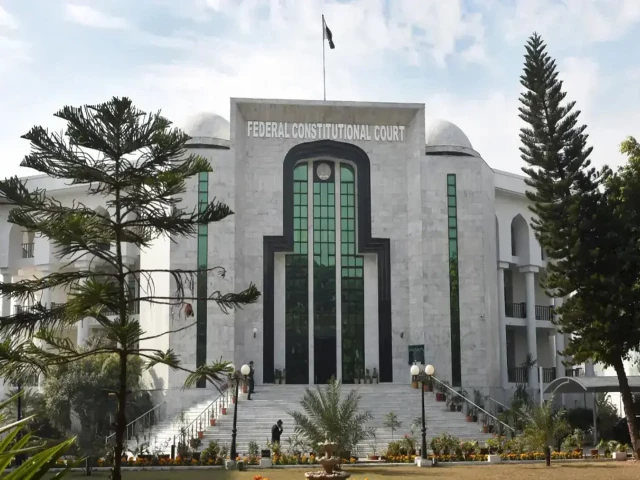
“Upholding the Lahore High Court (LHC) decision, the Federal Constitutional Court (FCC) has endorsed the Punjab government's notification regarding the ban on the publication of a book on the religion …”
A 14-page judgment authored by Justice Aamir Farooq stated that the Constitution guaranteed religious freedom, subject to law, public policy and morality. "At this juncture, it is necessary to pause. The petitioner's claim that Article 20 has been violated requires a careful examination of the validity, strength, and underlying reasoning of the bans imposed on the books/material under the Cr.
P.C. and the relevant Ordinance and the forfeiture thereof," the ruling explained. However, the judgment went on that, in the absence of actual material on the record, owing to the petitioner's failure to avail the appropriate remedies, the court is unable to proceed on mere assumptions.
A division bench of the FCC led by Justice Aamer Farooq said that it was restated that the assertion of counsel for the petitioners that the actions on the part of the executive violate their religious freedom clause seems to be an afterthought and was nothing more than wittering on about the subject of fundamental rights in general and the religious freedom clause in particular.
"Stay connected with Aman-e-Pakistan for ongoing live reporting and verified investigative updates."
The order said that the counsel, instead of making any attempt to show the court the content of the material and its impact, made a general discourse. "We are unable to decide the referred question in a purposive manner due to reasons noted in preceding paragraphs.
Hence, we can safely conclude that there was no violation of fundamental rights of the petitioners in the facts and circumstances. "The court said that the petitioner's assertion that his fundamental right under Article 20 has been infringed by the "executive" is, with respect, untenable.
"The correct approach is not to broadly label an act as "executive," but to determine the exact legal source from which the challenged action derives its authority. Only by locating that source; whether in statute, delegated legislation, or otherwise, can the Court meaningfully assess its conformity with the guarantees of fundamental rights.
"The order said that applying these principles to the case at hand, it becomes evident that the action cannot be characterised as a purely "executive action" in the broader sense suggested by the petitioner. "The constitutional framework clearly delineates a distinction between (i) actions taken in the exercise of bare executive discretion and (ii) actions undertaken pursuant to statutory authorisation.
"The FCC noted that fundamental rights under Chapter I, Part II of the Constitution are understood as a catalogue of guarantees conferred upon citizens and, in certain instances, upon all persons. "Yet, this orthodox formulation only captures part of the constitutional design.
The true source, the stream from which these rights flow, lies in Article 4, which operates as the foundational guarantee of the fundamental rights. It secures to every individual the right to be dealt with in accordance with law and affords equal protection thereof, thereby safeguarding personal liberty in its broadest sense.
""In this way, Article 4 does not merely stand alongside other rights; it undergirds the entire scheme, from which specific guarantees, including the freedom of religion, draw both meaning and force, even as the Constitution proceeds to delineate them expressly in subsequent provisions.
"The court said that where the judicial forum is empowered to decide a question of law, naturally, it can also decide the issue of fundamental rights as well. "Admittedly, the petitioners did not assail notification(s)/action on part of Government of the Punjab through remedy under section 99-B Cr.
P.C and s.20 of the Ordinance, respectively, within the prescribed limitation as specified in the referred statutes. ""Instead, they filed petitions under Article 199 of the Constitution. The referred petitions were filed after a considerable delay.
"The court noted that no plausible justification exists for such kind of delay and, as such, even in the grounds of the writ petition, nothing cogent has been mentioned as to the reason for delay in approaching the high court.
Continue Reading: More in National
Swipe or click arrows to explore National desk coverage