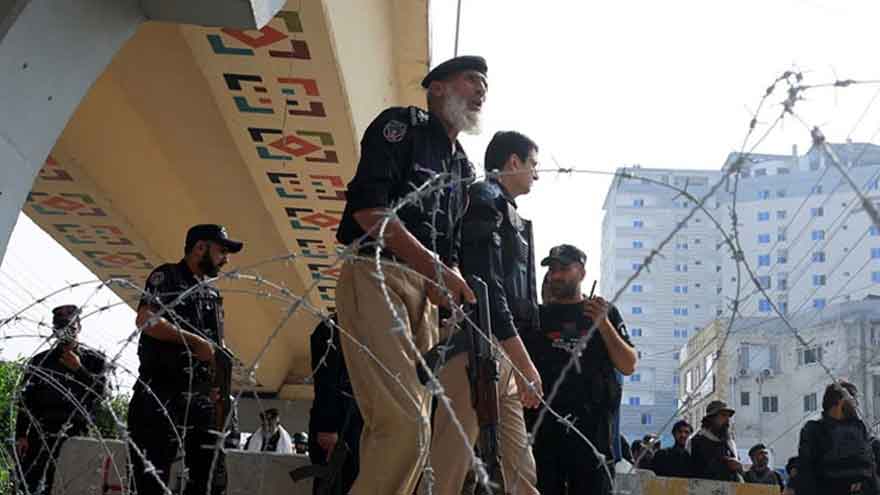
'Govt can't keep sleeping when it comes to citizens' security': DPM Dar on K-P emergency
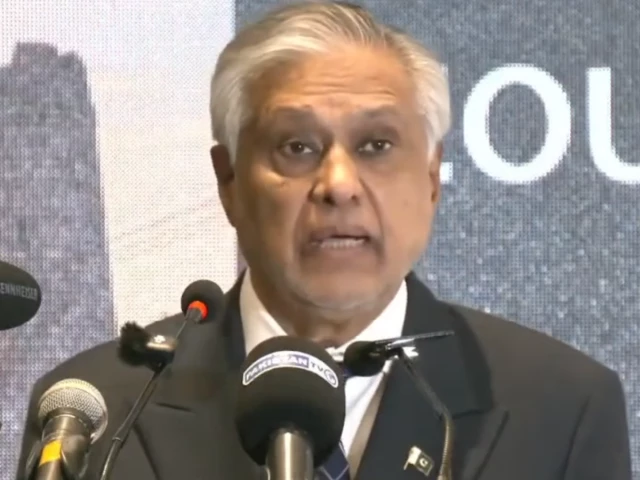
“Deputy Prime Minister and Foreign Minister Ishaq Dar on Monday defended the federal government’s decision to impose emergency measures in Khyber-Pakhtunkhwa (K-P), saying it had “no choice” but to act…”
“When it comes to the safety and security of our nationals, our citizens, wherever they live, any part of Pakistan, I think it is the duty of the federal government,” DPM Dar said at a conference on Pakistan’s evolving counter-terrorism landscape.
The federal governmentimposedgovernor’s rule in K-P on Sunday, with President Asif Ali Zardari approving Prime Minister Shehbaz Sharif’s advice under Article 234 of the Constitution. The decision came amid tensions between the Centre and the PTI-led provincial government over the security situation and counter-terrorism efforts.
The PTI rejected the move as unconstitutional and vowed to resist it. He said the government had determined that there was no alternative to the measures it had taken. “It’s not a political move.
"Stay connected with Aman-e-Pakistan for ongoing live reporting and verified investigative updates."
It is surely against the menace of terrorism which the province has been hit with in the last decade and a half,” he said. “Can we keep sleeping and looking towards another because it's a political move?
No, it's not.
I can guarantee you.”DPM Dar said the government had paid a heavy political price for difficult decisions in the past, including economic measures taken when Pakistan was on the brink of default, and that "whatever costs" the government has to pay to save the economy, to protect property and lives of the people, "I think it is never too much.
"He expressed confidence that the measures would produce results in the coming weeks and months, saying he hoped peace would return to the province, lives would be protected and radicalisation would end.
DPM Dar also referred to his experience of negotiating with the same political party in 2014, when a sit-in continued in Islamabad for 126 days, saying the government did not consider political differences a reason to avoid engagement. However, he maintained that public safety had to take precedence when the government believed action was necessary.
Losses in war against terrorismDPM Dar said Pakistan had paid an enormous human, economic and reputational price for terrorism, with economic losses exceeding $150 billion. “Mind you, Pakistan's total external debt is 130 billion dollars,” he said.
“The cost does not end here.”He said terrorism had tarnished Pakistan’s international image and undermined confidence in the country, while the damage to its reputation and the opportunities lost during that period were incalculable. “Pakistan has borne a dual burden: fighting terrorism, not countering the misperceptions that have too often obscured our sacrifices,” he said.
Recalling attacks on civilians, Dar referred to the children killed at the Army Public School in Peshawar, bombings at mosques, markets and bus stops, passengers taken hostage on a train, and labourers killed because of where they came from. “These are not just statistics.
This is the price the Pakistani nation has paid and continues paying,” he said. He said the government had made counter-terrorism a national priority, renewed national efforts and placed greater emphasis on implementing the National Action Plan.
The Federal Apex Committee had brought together civilian and military leadership to review threats and agree on measures to address them, he said. Deputy Prime Minister Ishaq Dar says Pakistan has been at the forefront of the war against terrorism for over two decades, adding that terrorism has tarnished the country’s global image.#Ishaq.
Dar#War. OnTerror#Counter. Terrorism#National.
Security#PakistanTVpic.twitter.com/YjL0TGZZYp— Pakistan TV (@PakTVGlobal)October 12, 2026DPM Dar said the prime minister had approved the. Azm-e-Istehkaminitiative with the consensus of the provinces and other stakeholders. The initiative brought together military, intelligence, law enforcement and diplomatic efforts to target terrorists and the networks sustaining them while addressing conditions that allowed extremism to take root.
He said the government had also agreed on measures to improve intelligence coordination and strengthen the role of the National Counter Terrorism Authority. “These efforts require close cooperation between the Federation and the provinces,” he said.
“Every institution has a responsibility and the national effort must continue with unity and resolve.”DPM Dar commended PM Shehbaz for his leadership and sustained attention to counter-terrorism.
He also paid tribute to the Chief of Defence Forces and the Chief of Army Staff and Field Marshal Asim Munir, saying the armed forces, working closely with law enforcement agencies, continued operations against terrorists and their facilitators. “They confront this danger daily, often at the cost of their own lives,” he said.
Efforts to engage with Afghanistan not yielded results. The deputy prime minister highlighted the repeated diplomatic efforts Pakistan had made to secure action against terrorist groups operating from Afghan territory, while seeking stronger economic and regional ties with Afghanistan.
He referred to three visits to Kabul in 2025, including a visit on April 19 after a four-year stalemate in relations, followed by another visit in July with the Uzbek foreign minister.
During the April visit, DPM Dar said he held detailed discussions with Afghanistan’s acting Prime Minister Mullah Mohammad Hassan Akhund, Deputy Prime Minister Abdul Ghani Baradar and Foreign Minister Amir Khan Muttaqi. He said the discussions covered trade, the economy, refugees and political matters, among other issues.
Pakistan had subsequently delivered on commitments it had made to Afghanistan, he said. “What does Pakistan ask? Only one.
Please do not allow your soil to be used against any country, particularly Pakistan, for terrorism,” he said. Pakistan had continued to pursue engagement, upgraded diplomatic representation and worked towards regional connectivity, including a proposed railway linking Pakistan and Uzbekistan through Afghanistan to Central Asia, he said.
Deputy Prime Minister Ishaq Dar says combating terrorism remains the government’s top priority, urging the international community to acknowledge Pakistan’s sacrifices in the fight against terrorism.#Ishaq. Dar#Counter. Terrorism#War.
OnTerror#Global. Security#PakistanTVpic.twitter.com/Cv. VeSRHhLR— Pakistan TV (@PakTVGlobal)October 12, 2026In August 2025, Dar and Chinese Foreign Minister Wang Yi had visited Kabul for a trilateral dialogue, he added.
“These were the sincere efforts on behalf of Pakistan,” Dar said. “But the one ask, we are not seeing a result, unfortunately, so far.”He said Pakistan wanted Afghanistan to become stable and prosperous and believed in the future of the Afghan people.
However, he said, the Afghan Taliban authorities needed to honour their counter-terrorism commitments and ensure Afghan territory was not used to launch attacks, particularly against Pakistan. “Sadly, as I said, we can no longer ignore the continuing terrorist threat emanating from Afghanistan,” he said.
DPM Dar referred to reports by the United Nations monitoring mechanisms documenting the presence of the Tehreek-e-Taliban Pakistan (TTP) in Afghanistan and its close links with Al-Qaeda. He said the threat had implications for regional security beyond Pakistan.
“Just imagine, if Pakistan was not fighting this war as a frontline fighter, this terrorism, God knows, would have spread by now to rich parts of the globe,” he said. He stated that attacks inside Pakistan were planned, directed and launched from across the border, with terrorists infiltrating Pakistan, attacking soldiers and civilians before retreating to their sanctuaries.
Pakistan had invested heavily in border fencing and management at considerable financial and human cost, he said. “But no fence can substitute for real action against these terrorist sanctuaries,” he said.
DPM Dar said Pakistan had raised its concerns directly and repeatedly, shared specific information and sought concrete action against terrorist groups and the sanctuaries from which attacks against Pakistan were launched. DPM Ishaq Dar addresses the conference on Pakistan’s evolving counterterrorism landscapehttps://t.co/e.
Vqf. DafW2J— Pakistan TV (@PakTVGlobal)October 12, 2026He also cited Pakistan’s decision to allow humanitarian aid to pass into Afghanistan despite a border closure following a wave of attacks in October 2025.
He said the United Nations had approached Pakistan’s Foreign Office for permission and that the country had allowed 1,000 containers of humanitarian aid to cross the border, a process that took almost a month. He said the decision demonstrated Pakistan’s commitment to Afghanistan’s development and prosperity.
The minister also recalled his efforts as finance minister to secure approval for the CASA-1000 energy project linking Tajikistan, Afghanistan and Pakistan. The project had been suspended by the World Bank and International Monetary Fund following political changes in Afghanistan, he said, but efforts had since been made to revive it.
He said Pakistan’s willingness to pursue economic cooperation had not diminished despite its security concerns. DPM Dar also recounted a conversation with Akhund during his July 2025 visit, saying the Afghan leader had thanked Pakistan for delivering on commitments within eight weeks.
“If you do not take appropriate actions against the terrorist groups in Afghanistan, the day will come, if your government is there, they will haunt you as well and you will be facing threats from the same terrorists in Afghanistan,” Dar said he had.
DPM Dar described the TTP as one of the greatest threats to Pakistan’s security, saying it had been responsible for some of the worst terrorist attacks in the country’s history, including attacks on schools, mosques, markets and security installations. He said the group’s victims included civilians as well as members of the security forces.
He also accused the Balochistan Liberation Army (BLA) of targeting civilians and security personnel while seeking to undermine Pakistan’s economic development. Among the incidents he cited was the hijacking of the Jaffar Express in March 2025, when more than 400 passengers were taken hostage.
He also referred to attacks on passenger buses, targeted killings of civilians in Rojhan, and assaults on security installations and infrastructure critical to Pakistan’s economic development. Deputy Prime Minister Ishaq Dar lauds Chief of Defence Forces Field Marshal Syed Asim Munir’s role in the fight against terrorism.
He calls on Afghanistan to take concrete action against terrorist groups operating from its soil.#Ishaq. Dar#Asim. Munir#Counter.
Terrorism…pic.twitter.com/sfxv. Dfmk. Vq— Pakistan TV (@PakTVGlobal)October 12, 2026DPM Dar said the groups did not operate in isolation and benefited from external support, including networks providing fighters, funding, weapons and training.
“Pakistan has repeatedly called for action against the support and the sanctuaries that enable their attacks,” he said. “A group that finds safe haven today to attack Pakistan can use the same safe haven tomorrow to threaten others.”He warned that ignoring the TTP and its supporters would not eliminate the threat but would give them time to grow.
He said Pakistan had consistently raised concerns with the international community about what it alleged was Indian support for terrorist organisations operating against Pakistan, including from Afghanistan. Pakistan had shared information with the United Nations and international partners documenting alleged Indian support for groups including the TTP and other proxies operating from Afghan territory, he added.
DPM Dar referred to former Indian naval officer Kulbhushan Jadhav, who confessed to involvement in terrorist activities, as well as what DPM Dar described as a record of extraterritorial assassinations, including in North America. He said alleged state sponsorship of terrorism had been documented and argued that the issue went beyond Pakistan’s bilateral disputes with India.
“When a state uses terrorist groups as instruments of policy against a neighbour, it puts the peace of the wider region at complete risk,” he said. “It undermines international law and relations between the states.
Such support must be confronted without political considerations or double standards.”Stronger bilateral cooperation. The minister stated that Pakistan was working to strengthen multilateral cooperation against terrorism and had used its position on the United Nations Security Council to advance international action.
He said Pakistan, an elected member of the Security Council for 2025-26, had chaired the 1988 Taliban Sanctions Committee and served as a vice-chair of the Counter-Terrorism Committee. These responsibilities provided opportunities to advance international cooperation and the implementation of relevant Security Council resolutions, he said.
Pakistan had also chaired the Shanghai Cooperation Organisation’s Regional Anti-Terrorist Structure during 2025-26 and used the forum to promote regional cooperation, he said. The deputy prime minister added that bilateral counter-terrorism dialogue, including with the United States, formed another part of Pakistan’s efforts to address shared threats and strengthen practical cooperation.
“Pakistan’s sacrifices deserve recognition, but recognition alone is not enough,” he said. He called for timely intelligence sharing, access to technology and further capacity-building support for law enforcement agencies. He also urged effective international action against terrorist financing, weapons supplies and the provision of safe havens.
“States must ensure that their territory is not used for terrorism against any other country,” he said. He also urged Pakistan’s partners to impress upon the Afghan authorities the need to fulfil their commitments. “A threat that endangers the region and the world cannot leave Pakistan to confront alone,” he said.
Modern-day warfareDPM Dar warned that terrorist groups were adapting their methods, using social media and encrypted platforms to recruit and radicalise people, raising funds through cryptocurrencies and other digital channels, and experimenting with drones and artificial intelligence to spread propaganda.
He said young people were increasingly exposed to extremist propaganda online and that individuals radicalised through digital platforms could carry out attacks without warning. Modern weaponry was also finding its way into the hands of terrorist groups, making the work of security forces more difficult, he said.
“No state or society can combat these challenges alone,” he said. “We need to share technology, intelligence, and experience.”Above all, he said, governments needed the political resolve to act against terrorism in all its forms and manifestations, without distinction or excuse.
“Those who killed our children in Peshawar claim to act in the name of Islam. They did not,” he said. DPM Dar referred to the Quranic principle that killing one human being was equivalent to killing all humanity, saying the principle did not distinguish between people on the basis of religion.
“They are criminals, they speak for no faith or religion, and they have no nationality or boundary,” he said, referring to terrorists. “Terrorism must never be equated with any religion, nationality, civilisation, or ethnicity.”He added that Islamophobia divided communities and provided terrorists with the propaganda they sought.
He said the response to terrorism had to remain firm while rejecting attempts to associate terrorism with a particular faith or community. Counter-terrorism should not suppress self-determinationDPM Dar said counter-terrorism efforts should not be used as a pretext to suppress legitimate struggles for self-determination recognised under the United Nations Charter and relevant Security Council resolutions.
He referred to Palestine and Jammu and Kashmir, as well as the conflict between Thailand and Cambodia, saying that Pakistan had promoted multilateralism and the peaceful settlement of disputes during its Security Council presidency the previous year. DPM Dar cited Resolution 2788, which he said had been unanimously adopted after 12 years without a similar unanimous resolution on the issue.
He said the resolution’s principles had subsequently been referenced in discussions at the United Nations during the Thailand-Cambodia conflict.
“Those who used to call Pakistan, probably because of the terrorism we have been actually fighting, a terrorist or some other state, now they are very happy to call Pakistan a peacemaker state after what we have done in the last few years,” he said.
He also referred to Pakistan’s efforts to mediate between the United States and Iran, saying the two sides had held direct talks for the first time in 47 years with Pakistan’s participation. The deputy prime minister said an agreement reached on June 18 had subsequently been violated by both sides, but Pakistan had not abandoned its diplomatic efforts.
“As late as just days before, in the high week of the UN General Assembly, on the sidelines of New York, we are making all possible efforts,” he said. He also referred to the growing strategic importance of the Strait of Hormuz and Bab el-Mandeb, saying developments affecting these waterways had wider implications for regional and international security.
Makkah defence framework. Concluding his speech, DPM Dar stated that Pakistan had entered into a joint defence agreement signed in Makkah on August 7, with its inaugural meeting held in Istanbul on August 31. He said Pakistan had the honour of providing the first secretary-general for a three-year term and that the headquarters would be in Riyadh.
A working committee was finalising the programme and operational details, he said. The framework included a Strategic, Political and Defence Committee comprising the foreign ministers, defence ministers and army chiefs of the three participating countries, he said.
“The idea is not any offensive. The idea is totally objective and defensive,” he said. “So it is for self-defence.
And it is nothing which is against any international law or charter.”DPM Dar cited Article 51 of the United Nations Charter, which recognises the right to individual and collective self-defence, and compared the principle with the basis on which NATO was established.
He said the ultimate objective was to promote peace and closer ties in the region, rather than target any other country. The agreement was also not restricted permanently to the three founding participants, he said, adding that its provisions would allow other countries to join once the framework was fully established, potentially within a year.
DPM Dar said Pakistan’s counter-terrorism policy, diplomatic engagement and defence cooperation were all aimed at improving security while promoting regional stability and peaceful relations.
Continue Reading: More in National
Swipe or click arrows to explore National desk coverage