Scientists succeed in growing potatoes in simulated moon soil
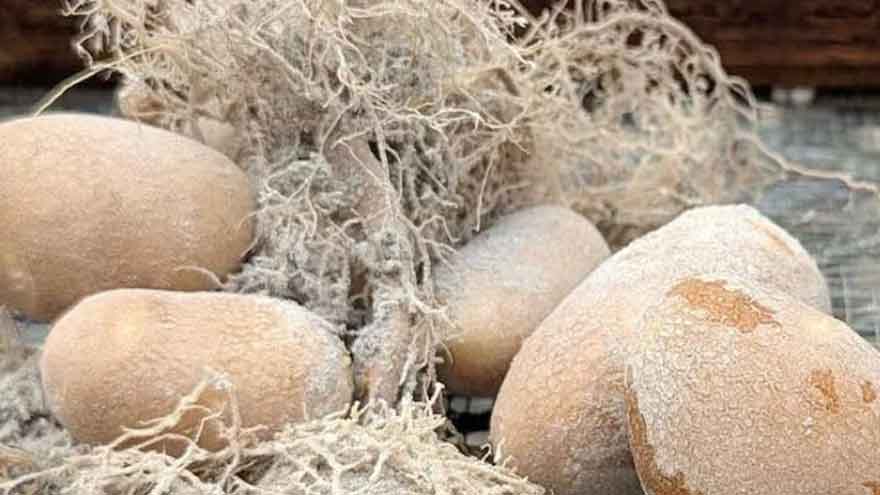
“Potatoes are one of the most important crops on Earth, a food that is a great source of starch, vitamins, minerals and fiber. They soon might be an important crop on the moon as well. Scientists have …”
They soon might be an important crop on the moon as well. Scientists have now succeeded in growing nutritious potatoes in simulated lunar soil that are safe to eat, with an eye toward feeding astronauts who may staff bases on the lunar surface in the near future.
They supplemented the lunar simulant with organic material, and found that with enough of it the potatoes grew just as well as they did in Earth soil. The research, supported by NASA, involved a variety called Modoc, an early-maturing potato with red skin and white flesh.
The United States and China both intend to send astronauts to the lunar surface in the coming years, with plans for long-term bases on the moon. A local food source is considered vital for sustaining people staffing a moon base because of the impracticality of transporting all needed food from Earth.
"Stay connected with Aman-e-Pakistan for ongoing live reporting and verified investigative updates."
"Potatoes provide more calories per land area than many other crops," said Oregon State University plant biologist Aymeric Goyer, who led the study published on Thursday in the journal npj Microgravity. "They are nutritious — they provide more potassium than a banana, are rich in vitamin C, have good proteins — and they have a high satiety index.
"That means they are a very satisfying food, as fans of french fries already know. The soil on the moon's surface is more properly called lunar regolith — basically crushed rock and dust, often sharp and glass-like, formed over billions of years by meteorite impacts.
It lacks organic material, unlike Earth soil. The researchers supplemented the simulated regolith with varying amounts of a nutrient-rich substance called vermicompost, produced when earthworms break down organic waste. "Lunar regolith does not contain any nitrogen, so no crop would grow without supplementing it," Goyer said.
Potatoes planted in regolith with no vermicompost produced almost no roots or tubers.
The plants grew some roots and tubers with a mixture containing as little as 5% vermicompost and 95% regolith. With a mixture of 30% vermicompost, the yield was identical to potatoes grown under the same conditions in Earth soil — specifically from Hermiston, Oregon, a locale known for impressive potato yields.
The researchers grew the potatoes in a greenhouse under sunlight and artificial light, with the temperature at 72 degrees Fahrenheit (22 degrees Celsius) during the day and 64 F (18 C) at night. So how did the potatoes taste?
"Unfortunately, we have not tasted them yet. We used what we harvested for lab analyses," Goyer said. SMALL POTATOESThe plants in the current study were grown in small pots, so the potatoes they yielded were small, generally less than a third of an ounce (10 grams), even in Earth soil.
"We are working on a second study where we report on the growth of potatoes grown in larger pots. In this case, we obtained potatoes of size you typically see at the store," Goyer said.
Lunar regolith is hostile to crops also due to high levels of heavy metals like copper. "Without organic matter, potatoes take up too much heavy metals, which can become toxic for the plants. Organic matter helps make heavy metals less available to the plants, so plants do not overaccumulate them," Goyer said.
Researchers have been experimenting with various crops for potential extraterrestrial agriculture. A study published in March documented chickpeas grown in lunar regolith supplemented with vermicompost. "People are also working with tomatoes, lettuce and legumes like alfalfa," Goyer said.
While work on lunar agriculture is important for establishing a sustainable human presence on the moon, it also may offer benefits on Earth, and study co-author David Handy. "The technologies that are invented as a result can be used to produce food in regions of low agricultural output that are reliant on shipments, such as inner cities and desert communities.
I believe continued research on the use of regolith will lead to techniques that can be used to improve soil quality, as well as remediate contaminated soils to improve sustainable agriculture here," Handy said.
Extraterrestrial potatoes already have germinated in popular culture, with a stranded astronaut played by actor Matt Damon harvesting them in a greenhouse on Mars in the 2015 film "The Martian. " So could lunar fries, baked potatoes, aloo tikki and vichyssoise be on the menu at a future moon base?
"It is a very versatile crop, so yes, all the above. In terms of ease of preparation, maybe microwaved," Goyer said.
Continue Reading: More in National
Swipe or click arrows to explore National desk coverage