Nadia Khan's gym questions overshadow Parishae Adnan's NYFW achievement
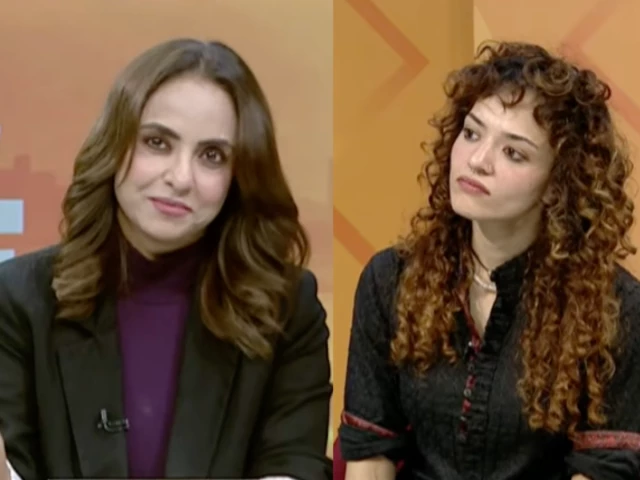
“TV host Nadia Khan faced criticism over her interview with designer Parishae Adnan, with viewers questioning why a conversation following the designer’s New York Fashion Week achievement repeatedly fo…”
Parishae recently appeared on. Rise and Shine, co-hosted by Khan and Zohaib Hassan on365 News, following her appearance at New York Fashion Week, where she closed Flying Solo’s showcase with her collection. Second Skin.
The collection centred on sustainability and the reworking of existing garments, bringing Pakistani craftsmanship and fashion heritage to an international runway.
Yet rather than keeping the conversation primarily focused on the collection or the technical aspects of her work, the interview repeatedly moved towards Parishae’s personal choices — including how she dresses, her gym videos, her boundaries and whether her parents object to her appearance.
"Stay connected with Aman-e-Pakistan for ongoing live reporting and verified investigative updates."
Despite the direction of the conversation, Parishae remained composed and continued trying to bring the discussion back to fashion, creativity and the reasons behind her choices. “It is expressive, whether that is to be in the gym, dressing a certain way, doing your hair or whatever someone does,” Parishae said.
“Humans are multifaceted. You can’t take one thing and run. We are all multidimensional.
You might like cooking or running, so I don’t put myself in a label either. What is more important is people don’t define us,” she added. The discussion around Parishae's appearance became one of the most striking parts of the interview.
Khan questioned Parishae about the way she dresses, including references to her dressing “like a man”, and asked her to show off her muscles before the conversation moved towards the broader question of how she expresses herself. Parishae resisted the idea that one element of her appearance should be used to define her.
For her, clothing is simply another form of expression. She also described herself as having “always been a rebellious kid” and later added, “I am a very religious person too by the way”, after the hosts continued to question her way of dressing.
The discussion eventually moved towards boundaries and whether they can be defined universally. “I don’t think anything is rigid. Art is subjective.
What is your boundary isn’t always mine or someone else’s,” Parishae said. It was a point that became particularly relevant when Khan returned to the subject of Parishae’s gym videos. The gym question“Being in society, the gym videos you make, there is criticism, so does that not worry your parents?”
Khan asked. Parishae's response, however, moved the conversation away from what she wears and towards why she shares her fitness journey publicly. “Yes, maybe, but I think safety is a concern.
But besides that, what gets me up and takes me to the gym is when I get messages in my inbox from all those girls, women, even women who get inspired by seeing it and go to the gym themselves. That’s a big thing,” she said.
She also explained that representation was something she had lacked growing up. “When I was young, I didn’t have anyone like that to show me I can have those genetics or who is a close Pakistani I can follow who has body-ideal.”For her, sharing the journey is therefore not simply about displaying her own body or lifestyle.
It is also about showing other people that such a journey is possible. The repeated return to her gym clothes nevertheless stood in contrast to the reason she had been invited onto the programme in the first place.
However, Parishae used the opportunity to talk about her work. View this post on Instagram‘It was not handed to me’One of the recurring assumptions Parishae addressed was the idea that coming from a prominent fashion family meant her career was simply given to her.
Parishae is the daughter of designers Amir Adnan and Huma Adnan, but she explained that fashion was not initially the career she chose. “Never once have my mother or father this career. I did everything besides this field at first.
Consulting, business, hospitality, management, even hospital care during COVID.”Her eventual return to fashion, she explained, changed the way she viewed the profession. “When you do the full circle and come back, it is a different kind of love for craft.”Parishae also addressed the “nepo-baby” label, offering a different perspective on children entering family businesses.
“When I was growing up, people used to call me ‘nepo-baby’, but I thought about it in the past 10-15 days. If you look back at the old days, these kids were called ‘apprentices’. So going from one generation to the next is by putting their kids into the business.”
“I feel like this has been my journey too. It was not handed to me, but I grew up in clothes and sewing.”For her, being raised around fashion did not mean automatically inheriting a creative identity.
“Even education-wise, my father ’t teach creativity, it is just naturally there. It shows more when you work on it and ‘do it’ rather than learning it.”A bigger conversation about Pakistani fashion. The interview also offered Parishae an opportunity to discuss what she believes is missing from conversations around fashion and other creative industries in Pakistan.
She questioned why discussions about creative work in Pakistan can sometimes focus on the spectacle surrounding it rather than the technical work involved. “We were talking on boundaries. We often talk about art and not these things and we are here on TV discussing boundaries.
I wanted to make an interesting point. I believe going to NYFW is a big accomplishment, but the bigger thing was that whatever appreciation you get from there was more technical, but here there is not that kind of technicality discussed.”Parishae compared the discussion around fashion to the way acting is often treated.
“For example, when acting is discussed, people don’t discuss it as a craft. Over there, same things are discussed, like in my line of work: strutting, stitching, line of flow.
If you sit in craft, you have to know it.”Her comments highlighted a broader frustration: that audiences can spend more time discussing personalities, appearances and spectacle than the actual craft behind creative work. The collection behind the NYFW appearance.
Parishae's New York Fashion Week appearance itself was rooted in a concept she had explored previously, which she said was not discussed during the interview. Fans subsequently criticised the hosts for what they viewed as a lack of research.
“This is not a new concept. I did a show like this in 2020 in Pakistan, which I got a lot of criticism for. Very similar work.
Concept, philosophy, technique, structure — almost all identical.”She said she had previously presented the same philosophy and approach in Pakistan, where the concept of reusing old clothing was not necessarily understood in the same way.
“People here in this society didn’t understand the concept of reusing old clothes.”For Parishae, this is particularly relevant as thrifting and reuse become increasingly important to younger generations.
To conclude, she said: “In our generation, thrifting culture is important too because we teach this generation and next that we can’t make old stuff again how it is.”The criticism surrounding the interview largely stemmed from the contrast between the occasion and the direction of the questioning. Parishae was appearing after taking.
Second Skinto New York Fashion Week and closing Flying Solo’s showcase. Yet some of the most prominent questions directed at her centred on what she wears to the gym and whether her parents are concerned about it.
View this post on Instagram. The exchange subsequently drew criticism on social media. Parishae herself shared clips of her reactions to the interview, while her mother, Huma, described the questions as “uncalled for”.
What makes the interview particularly notable is that Parishae did not respond by turning the exchange into an argument. Instead, she continued answering even when the conversation moved into questions about her appearance, boundaries and gym videos, trying to explain the thinking behind her choices.
And when the discussion moved towards fashion, she offered a detailed account of craft, sustainability and the technical aspects of her work.
For Parishae, that meant not being reduced to a designer with famous parents, a woman who works out, someone who dresses a certain way, or even a designer who has just appeared at NYFW.She was making a case for being seen as all of those things at once. And perhaps that was the conversation worth having in the first place.
Written by Sheheryar Munawar
Aman-e-Pakistan Senior Journalist & Bureau Reporter
Continue Reading: More in National
Swipe or click arrows to explore National desk coverage