Waste plastic to art: From Nisbat Road to Troutman Street
“For visual artist and sculptor Khalil Chishtee, art is not merely a profession or a medium it is a way of life shaped by memory, place and everyday experiences. His latest solo exhibition, Nisbat Road …”
His latest solo exhibition, Nisbat Road to Troutman Street, brings together a new body of work inspired by two places that have played an important role in his life: Nisbat Road in Lahore, where he grew up, and Troutman Street in Brooklyn, New York, where he has been based for many years.
The exhibition opens at Sanat Initiative in Karachi on Tuesday. Speaking to The Express Tribune, Chishtee said the title of the exhibition reflects both his personal journey and the visual similarities he has observed between the two locations.
"I was born and brought up in Lahore," Chishtee said. "Near the city of Lahore, there is a place called Nisbat Road where I spent my youth. "He later studied at the National College of Arts (NCA) and taught sculpture for 11 years.
"Stay connected with Aman-e-Pakistan for ongoing live reporting and verified investigative updates."
During his time in Lahore, he also worked on a number of commissioned sculpture projects before moving to the United States. Now based in Brooklyn, Chishtee said his memories of Lahore continue to influence his artistic practice.
"Nisbat Road, Lahore, is a very famous place," he said, recalling how the area was once closely associated with film posters and painted film boards. For Chishtee, the walls of Lahore during his childhood were an important part of the city's visual culture.
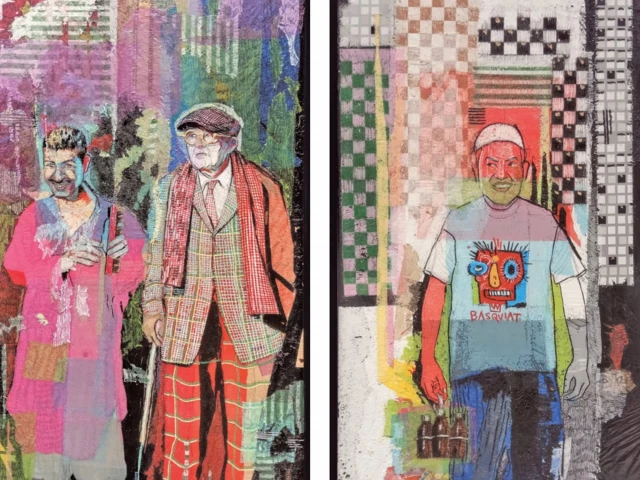
"Posters on the walls, paintings on the walls, graffiti, it was a very normal visual culture in the 70s when I was growing up," he said. He later found a similar form of visual expression in Brooklyn's Bushwick neighbourhood, particularly around Troutman Street, which is known for its vibrant street-art culture.
This idea of layers became central to his latest work. "You see a glimpse of something else from below," he explained, describing how layers of paint, posters and other materials can reveal traces of what came before.
The concept also has a personal meaning for the artist. As people grow older, he said, memories from different periods of their lives begin to overlap. While the works may initially appear to be paintings, Chishtee said they are created using an entirely different process.
"I am not a painter, so I don't know how to paint," he said. Instead, he uses discarded plastic bags, including shopping bags and kitchen bin bags, to construct his works. The material is layered, torn and manipulated to create colourful surfaces and figures.
"These are not paintings," he said. "These are colourful bags. "Chishtee has been creating plastic structures since 2005 and is particularly known for his life-size human figures made from waste materials.
He describes the practice as recycling and upcycling. The artist said he does not use glue in the process and uses heat to create lines and textures within the plastic. "I can't call this painting, because it is not painted," he said, explaining that the medium is essentially plastic waste.
The human figure remains at the heart of his work. "I am a very figurative person," Chishtee said, explaining that he has been drawing figures since childhood. For him, observing the human form involves paying attention to even the smallest details, from fingers and posture to the physical presence of a person.
"You go to the soul of the person inside," he said. Chishtee also sees his use of discarded plastic as more than an environmental statement. He said he began working with the material long before sustainability and environmental art became popular trends.
"When I started doing this material in 2005, it was not a trend," he said. "Trends change. What the heart says does not change.
"For Chishtee, environmental responsibility is therefore part of his lifestyle rather than a theme adopted for an exhibition. Reflecting on the importance of art, he said, "I think there is nothing more important than art.
"But he believes art extends far beyond the artwork itself. "Art is not just art," he said. "Art is the problem of your life.
"
Continue Reading: More in National
Swipe or click arrows to explore National desk coverage