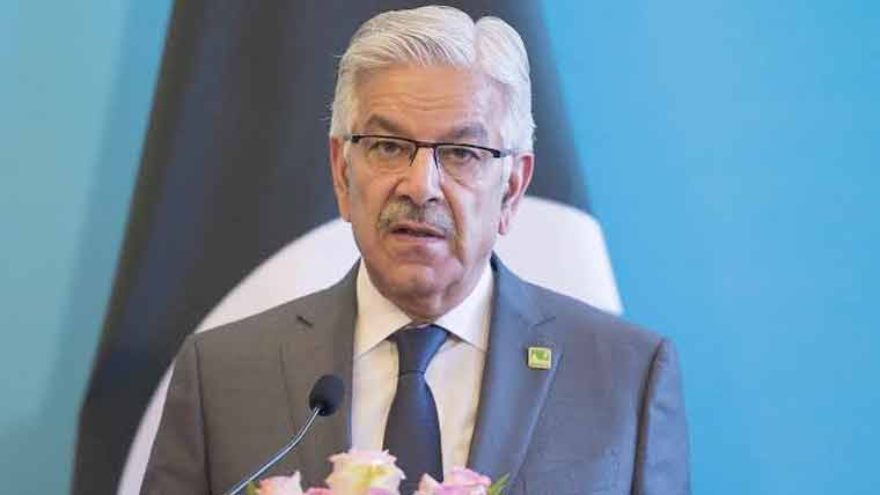
'We will honour it': Asif warns of Makkah defence pact's activation after Houthi strikes against Saudi Arabia
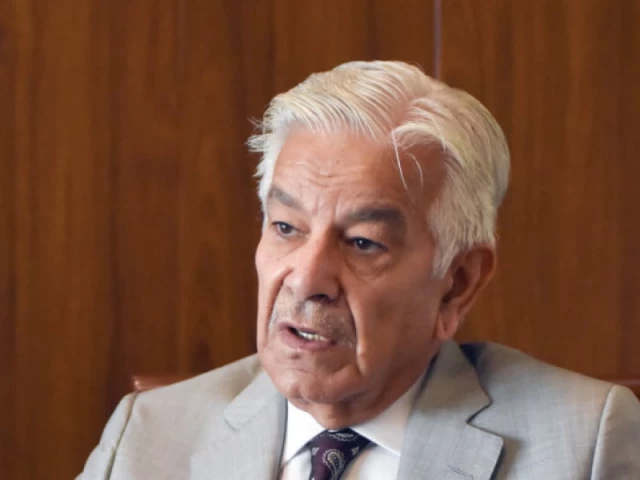
“Defence Minister Khawaja Asif said on Tuesday that there should be no ambiguity that an attack on any one country of the Makkah Defence Alliance — a joint defence agreement between Pakistan, Saudi Ara…”
The statement came as Yemen’s Houthis targeted cities and economic infrastructure in southern Saudi Arabia, injuring at least 73 civilians and further threatening peace in the region. The attacks also raised concerns about the conflict spilling over into the wider region.
Pakistan condemned the attacks targeting Abha, Khamis Mushait, Jazan and Najran, calling them a flagrant violation of the sovereignty and territorial integrity of Saudi Arabia. It reiterated its unwavering support for the kingdom’s sovereignty, territorial integrity, security and prosperity.
Speaking on a local television programme 'Aaj Shahzeb Khanzada Kay Saath', Asif said any unprovoked aggression or spillover of the conflict in Yemen into Saudi Arabia would activate the agreement. “There should be no ambiguity; there is no need for any clarity that this is a joint defence agreement,” he said.
"Stay connected with Aman-e-Pakistan for ongoing live reporting and verified investigative updates."
“There should be no doubt about this. We are bound by the terms and conditions of this pact and, God willing, we will honour them in case there is a need,” the minister added. Asif said he had no information about any contact between Pakistan and Saudi Arabia regarding the recent attacks.
He explained that the agreement provided for mutual assistance in the event of aggression. “This is not an aggressive agreement under which the three countries would, on their own initiative, attack another country. But if there is any aggression against one member state, all three member states will respond,” he said.
The minister expressed hope that the situation would normalise and tensions would subside while cautioning the Houthis that they would have to realise that their internal affairs could have consequences if they attempted to export the conflict beyond Yemen. “If they try to export them, the clauses of this agreement to counter aggression will become operative,” he said.
Describing the Houthis as non-state actors, Asif said there was sympathy and affection for Iran across the Muslim world, including Yemen, and there was no doubt about this. “But if non-state actors are used to exploit any bilateral dispute, I think they will be doing it at their own peril,” he said.
Asif said the agreement could also serve as a deterrent and did not necessarily mean that Pakistan and its allies would respond to aggression in kind. “We don't need to respond to a brick with a stone,” he said, adding that the alliance between three militarily strong countries that had already demonstrated their capabilities should itself serve as a deterrent.
He said Saudi Arabia should not be dragged into what he described as an internal dispute in Yemen. The minister recalled a similar situation in 2014, when Yemen attacked Saudi Arabia, saying Pakistan had supported the kingdom even though there was no formal agreement between the countries at the time.
He attributed Pakistan’s support to the sanctity of Saudi Arabia and the close relations between the two countries. Despite the continuing deterioration in the situation, Asif said he remained hopeful that a path to peace would emerge and that the doors to dialogue had not been closed.
“The path to peace will certainly emerge, and the doors have not been closed,” he said, adding that he would not abandon hope that the situation had reached a complete deadlock or that all avenues had been shut. He said indirect contacts with the parties were already taking place.
“We want to create an environment in which there is peace in the region because the entire region is at stake,” he said, adding that Israel would want to continue the conflict.
“I believe the global conscience is awake and the pressure of this global conscience will ensure that peace is ultimately established in the region, and Israel will eventually pay the price,” he concluded. The latest attacks were not the first time the Houthis had targeted Saudi Arabia’s energy interests.
On July 23, the group said it hadstruck two Saudi oil tankersin what it described as part of a naval blockade against the kingdom. The Houthis control areas near the Bab el-Mandeb Strait, one of the world’s key shipping routes linking the Red Sea with the Gulf of Aden, giving the group the ability to threaten vital maritime traffic.
The strikes had followed growing tensions between the Houthis and Riyadh. After the group threatened further attacks, the Saudi-led coalition supporting Yemen’s internationally recognised government vowed to respond with “unprecedented determination and force” to any attempt to target the kingdom, its citizens or its national assets.
Makkah defence pact. The recent Houthi attacks came at a time when Pakistan, Saudi Arabia and Türkiye had justformalisedtheir longstanding strategic ties through the signing of the “Makkah Defence Alliance, a trilateral security framework that its proponents describe as a defensive arrangement aimed at strengthening collective deterrence, enhancing military cooperation and promoting regional stability.
The agreement, signed during the Makkah Al-Mukarramah Summit for Joint Defence, prompted comparisons with military alliances such as NATO. However,, the pact is intended to formalise decades of existing strategic cooperation rather than create a new military bloc or offensive alliance., the agreement represents the natural progression of longstanding political, military and strategic relations among the three countries.
They noted that Pakistan's ties with Turkiye dated back to the Khilafat Movement, while Pakistan and Saudi Arabia maintained decades of defence, political, economic and diplomatic cooperation based on what they describe as mutual trust and shared strategic interests.
Rather than establishing an entirely new partnership, analysts said the agreement provides a formal institutional framework for cooperation that has evolved over many years. Security analysts argued that the agreement reflected a rapidly changing regional security environment.
They pointed to regional conflicts, evolving security threats, and changes in the character of modern warfare as factors driving closer strategic coordination among countries that shared common security interests., the trilateral framework was intended to preserve regional stability by strengthening collective security mechanisms instead of relying on ad hoc bilateral cooperation.
At its core, the agreement established a framework based on the principles of collective security and collective deterrence. Security analysts said its central premise was that aggression against one member would be regarded as a threat to all three, thereby increasing the potential cost of military action and discouraging conflict through credible deterrence.
The framework also envisaged expanded defence cooperation, including closer military coordination, intelligence sharing, strategic consultations, defence planning and broader institutional cooperation between the three countries., pooling military capabilities and strategic coordination were intended to improve preparedness while reducing the likelihood of regional conflict.
Continue Reading: More in National
Swipe or click arrows to explore National desk coverage