67% Pakistanis see climate as lost cause
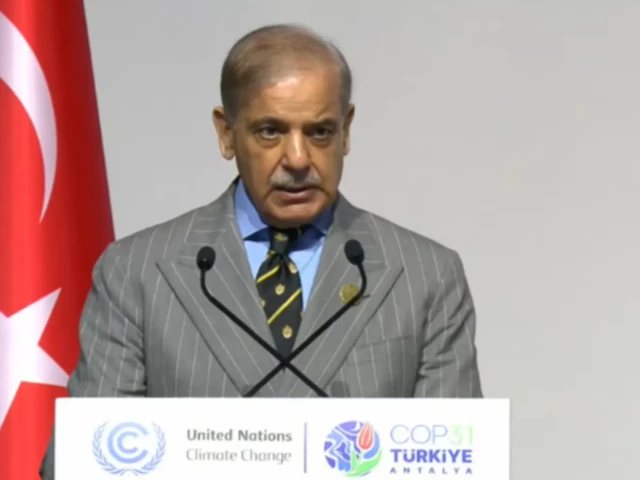
“Pakistan has called for grant-based climate finance and a substantial increase in international resilience and adaptation funds, warning that vulnerable countries cannot shoulder the consequences of c…”
"National effort cannot replace a fair and just global response when climate disaster strikes. Vulnerable countries need timely help and finance that does not deepen their debt.
We call for grant-based finance, including public-private partnerships, alongside significant enhancement of resilience and adaptation funds, which amount to survival funds, especially for struggling economies," Prime Minister Shehbaz Sharif said while addressing the COP31 summit in the Turkish city of Antalya on Thursday.
However, while Pakistan continues to press for international assistance, an economist has warned that growing dependence on external support and weakening confidence in collective action could leave vulnerable countries increasingly exposed to climate risks.
"Stay connected with Aman-e-Pakistan for ongoing live reporting and verified investigative updates."
Public pessimism about the possibility of containing climate change was growing, said Afia Malik, an economist and policy researcher formerly at the Pakistan Institute of Development Economics, not because people doubted the science behind it, but because confidence in collective action was weakening.
The WIN Worldviews Survey 2026 found that 67% of Pakistanis believed it was already too late to curtail climate change, compared with 42% of respondents globally. In Pakistan, 27% totally agreed and 40% somewhat agreed with the statement, while 31% disagreed.
The survey also revealed a slight gender gap in perceptions of climate change in Pakistan, with women expressing greater pessimism than men. Some 68% of women believed it was already too late to curtail climate change, compared with 64% of men, suggesting that the sense of climate fatalism was marginally more pronounced among women.
She said donor governments were increasingly preoccupied with their own energy security, inflation, public debt, geopolitical tensions and domestic political pressures, leaving climate commitments competing with more immediate concerns. Countries such as Pakistan faced serious challenges in adapting to climate change because of their heavy dependence on international support for recovery and adaptation, she said.
While climate justice remained an important argument, countries that had contributed little to global emissions should not bear the greatest economic and human costs of climate change, she cautioned, adding that moral arguments alone might not secure the required funding, particularly as donor governments faced their own financial and political constraints.
She said Pakistan should not wait for international support before undertaking domestic reforms within its control. Improvements in land use, infrastructure, water management, agricultural adaptation, local institutions and climate-related spending should not depend solely on fresh international grants.
Malik also argued that Pakistan's message at COP31 should extend beyond demands for financial support to stronger global action against further climate deterioration and domestic measures to reduce vulnerability. These should include reducing methane emissions, given Pakistan's position among the leading methane emitters, and enforcing regulations governing flood-prone areas, she said.
The need to make climate finance more responsive to communities facing climate risks has also been highlighted by State Bank of Pakistan Governor Jameel Ahmad recently. "Climate finance must do more than support green investments.
It must also help communities anticipate risks, build resilience, and adapt to a changing climate," he said. He has pointed to the vulnerability of smallholder farmers, micro and small enterprises and low-income households, which often lack insurance, savings and access to formal finance to recover from climate-related losses.
For Pakistan, the challenge extends beyond securing funds to rebuild after disasters. It also involves developing the capacity to anticipate risks, protect exposed communities and manage the consequences of climate change that can no longer be avoided.
She warned that the real danger was not simply that international climate finance might fall short of the needs of vulnerable countries. Losing trust in collective action could lead to more frequent disasters, greater economic losses and a continuing dependence on emergency assistance.
Continue Reading: More in National
Swipe or click arrows to explore National desk coverage