Lady JustitAIa

“Nowhere in human history has there been a transformation as swift and as sweeping as the one brought about by AI. Past inventions were gradually integrated into human societies, allowing sufficient ti…”
Past inventions were gradually integrated into human societies, allowing sufficient time to assess their utility and adapt to ideological, societal and customary changes. AI, however, is being adopted at an unprecedented pace, even as a substitute for accumulated human learning, experience and judgement.
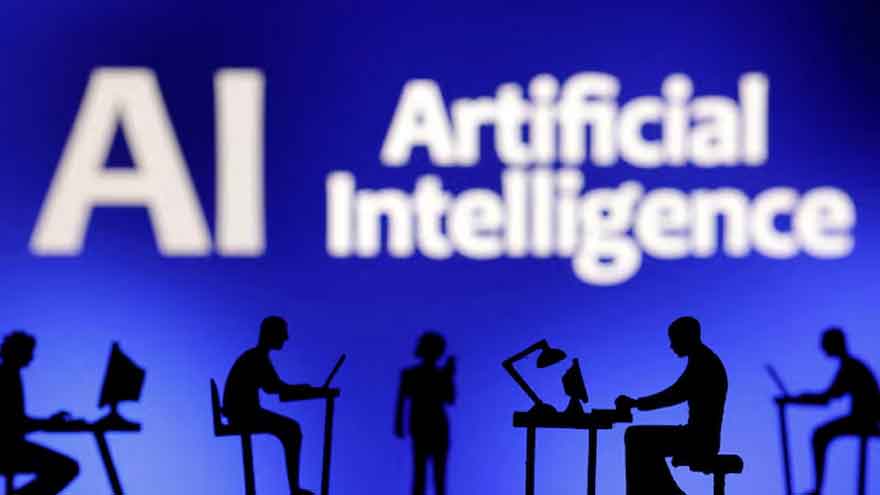
This leaves little time to assess its implications or reconcile technological advancement with human values and agency. Like other fields struggling to evaluate and integrate AI while maintaining human oversight, the judicial system is undergoing AI-sation or, more aptly, Just-AI-cisation.
Metaphorically speaking, the hasty adoption of AI for convenience could alter the lub-dub - the inherent moral force and legal fairness of the judicial system, personified by Lady Justitia. She could become Lady JustitAIa - the same blindfold, the same scales, but with a calculator and an algorithm humming beneath the robes.
"Stay connected with Aman-e-Pakistan for ongoing live reporting and verified investigative updates."
Although AI's contribution to the administrative aspects of justice is acknowledged, concerns are being raised about its potential role in judicial reasoning. Chief Justice John Roberts of the US Supreme Court has warned of risks such as "dehumanising the law and violations of privacy.
" Colin Birss, the appellate judge of England and Wales, supports AI's role in democratising access to judicial support and sorting massive files without replacing human decision-making or reasoning. Legal philosopher Amin Afrouzi critiques automated judges as "conceptually undesirable," arguing that statistical correlations are constrained in offering genuine legal rationale.
In a landmark 2025 Supreme Court ruling (C.P. No. 1010-L/2022), former Supreme Court judge Syed Mansoor Ali Shah addressed AI's potential to reduce the case backlog and the risks its undue reliance could pose. The judgment flagged the potential for "automation bias" in AI-generated responses amid eroding human scrutiny.
Since the circumstances and facts of each case vary, AI's fixed algorithms, if used in reasoning, risk undermining the imperative of judicial acumen and of restorative and rehabilitative justice. Therefore, it should never replace human judgement in judicial reasoning or sentencing.
Nevertheless, AI has considerable potential in judicial administration, legal research and case management. Its applications include e-courts, docket management, case scheduling, resource allocation, document organisation, classification, redaction and chronology-building. AI can thus save time by enabling judges and staff to focus more on complex analysis and interactions.
Although using AI to draft routine orders, notices and correspondence may improve efficiency, overreliance could weaken a judge's individual writing style and independent legal expression. AI's use in legal research also requires particular scrutiny.
For instance, a senior Crown prosecutor in the UK recently cited a non-existent legal precedent, an error that has sparked concerns about AI-generated hallucinations affecting judicial proceedings. Hallucinated legal precedents, loss of accountability, algorithmic bias, "black-box" logic and privacy risks are among AI's gravest challenges.
If left unaddressed, these risks could outweigh its benefits. Therefore, even in an assistive role, a "human-in-the-loop" framework is essential. AI's role must be limited to a cautious assistant, never allowed to claim evidence assessment or final rulings.
Its application should be limited to administration and research support - a role that jurists often summarise in the line: "AI must be the clerk, not the conscience of the court. " Or, to put it another way, keep Lady Justitia from turning into Lady JustitAIa.
Continue Reading: More in Tech
Swipe or click arrows to explore Tech desk coverage