Cat got your sense of humour
“Back to Tribune. HomeT-Magazine. Cat got your sense of humour? T-Magazine. Next Story. Cat got your sense of humour? Is the foul-mouthed animated series Alley Cats the cultural crime critics claim it is? By. Faiza…”
Back to Tribune. HomeT-Magazine. Cat got your sense of humour? T-Magazine. Next Story. Cat got your sense of humour? Is the foul-mouthed animated series Alley Cats the cultural crime critics claim it is? By. Faiza Shah|facebooktwitterwhatsuplinkdedemailPUBLISHED
August 30, 2026The modern television review has become less about evaluating a piece of entertainment and more about participating in an ongoing cultural trial where the verdict was written three years ago.
Alley Cats, Netflix’s six-episode animated series created by Ricky Gervais has people up in arms. Before anything was aired, the knives were already sharpened, oiled, and gleaming in the light of high-minded indignation.
"Stay connected with Aman-e-Pakistan for ongoing live reporting and verified investigative updates."
If you were to rely entirely on the critical consensus, you would assume Gervais had personally broken into the homes of cultural commentators, kicked their house pets, and left a flaming bag of vulgarities on their doorsteps.
Critics have lined up to declare the show a black hole of joy, a creative dead end, and a depressing indicator of its creator's inevitable decline. I’m no fan of Gervais but the show was recommended by a friend so I put it on.
But, I was watching it without the heavy burden of ideological warfare resting on my shoulders. So, I laughed when I found the irreverent and absurd jokes funny without judging the creator of the animation.
Not just a politely approving sensible chuckle, mind you, but the kind of sudden, unprompted snort that forces you to put your smartphone face-down on the coffee table. Alley Cats is, by any reasonable metric of modern background television, surprisingly funny.
It is silly, irreverent, absurd, and completely unconcerned with being a masterpiece. Why, then, are so many people treating a fifteen-minute cartoon about foul-mouthed strays as if it were a direct assault on Western civilisation?
To answer that, one must look at what the subject of review actually is, rather than what critics wished it were. The Alley Cats follows a ragtag group of feral cats eking out an existence in a bleak urban landscape.
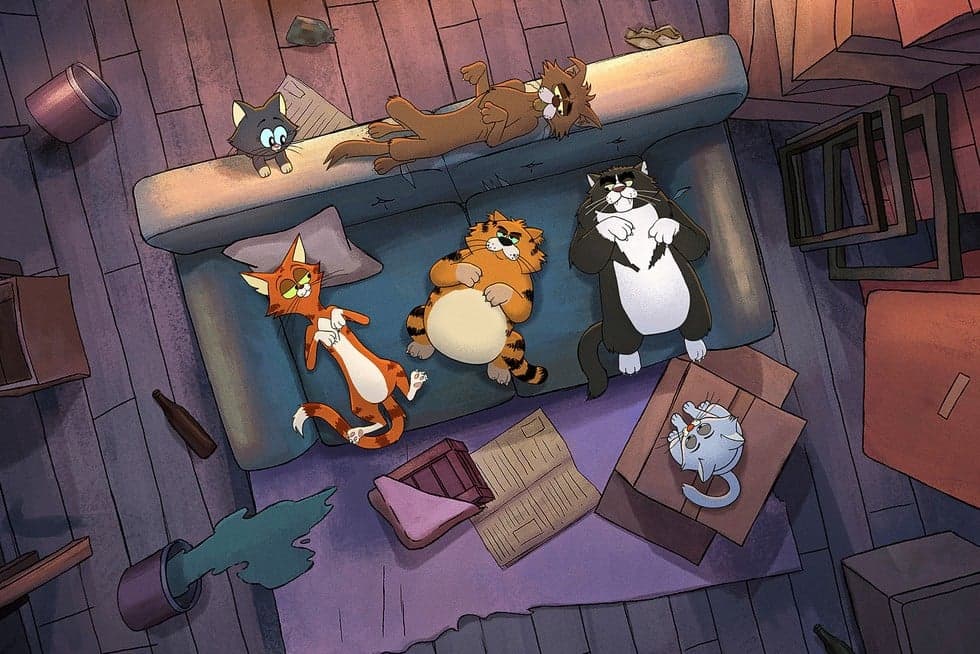
At the centre of this flea-bitten ensemble is Gus, voiced by Gervais with his trademark blend of smirking complacency and casual misanthropy. Gus considers himself the undisputed top cat of the alley, a position that requires very little effort beyond sitting on a discarded sofa, complaining about the world, and berating his companions.
His inner circle consists of archetypal distortions. There is Fang, the brute whose entire problem-solving framework relies on physical violence; Puke, a relentlessly grotesque creature whose dialogue seems explicitly designed to test the boundaries of human tolerance; and Ponce, a pampered pedigree cat whose life of domestic luxury and recent neutering make him the endless target of the gang’s mockery.
Adding to the chaotic dynamic are Olive, (Diane Morgan of Cunk on Earth fame) Gus's supposedly thick half-sister who constantly subverts expectations, and Kitten, a lost, innocent black kitty who wanders into their squalor and unintentionally forces these cynical degenerates into something resembling a family unit.
The plotting is deliberately thin, serving primarily as a clothesline upon which to hang long, absurd conversational riffs. Like Seinfeld (self-described as a show about nothing but hailed as a comic masterpiece) the banter is it.
It’s where the lines of absurd humour are supposed to make you laugh. In one episode, the gang becomes fixated on the idea of hunting down and eating a bee, ignoring Ponce’s reasonable warnings until disaster predictably strikes.
In another, they watch civil unrest on a television set through an apartment window and decide the only logical, high-stakes challenge left for them is to band together and take down a fat schoolboy walking home. This is not high comedy, nor does it pretend to be.
It exists in the same realm of unpretentious, feline-centric absurdism as the chaotic universe of God Cat vs. Evil Cat from The Oatmeal, or Netflix’s own Exploding Kittens adaptation. Where those properties treat animal behaviour as a cosmic engine of madness, Alley Cats grounds its absurdity in human pettiness.
It uses cats to mirror our own grotesque vanity, our absurd social hierarchies, and our terror of our own mortality. It is precisely that underlying focus on mortality that connects Alley Cats to Gervais’s previous live-action work, specifically After Life.
For all the crude jokes and relentless profanity that critics love to count up like bean counters at an accounting firm, the show is quietly obsessed with grief, love, family and existential dread.
When Kitten asks Gus about the scary reality of dying, or when the gang confronts the sudden, bloody loss of a fellow stray on the pavement, the comedy briefly falls away to reveal a surprising emotional sincerity. Gervais the sentimentalist has always existed right alongside Gervais the provocateur.
After Life divided audiences for precisely this reason, balancing bleak, unyielding grief with heartwarming small-town humanity. In Alley Cats, that same emotional architecture is depicted in two-dimensional animation. It gives the show a bizarre, bittersweet rhythm that turns on a dime between graphic absurdity and genuine tenderness.
Gus taking on a surrogate father role for Kitten isn't a cynical ploy; it is Gervais using cynical armour to protect a deeply sentimental core. The voice cast does the heavy lifting to ensure these transitions work.
Surrounding himself with reliable British comedy heavyweights, Gervais lets actors like David Earl, Tom Basden, Morgan, and Jo Hartley run wild with the dialogue. Their collective comedic timing elevates what could have been a tired exercise in shock value into something engaging.
Hearing Basden deliver polite, refined philosophical musings as Ponce while being endlessly shouted down by a group of feral degenerates carries a specific, joyful energy.
The banter moves quickly, the cadence is sharp, and the execution is tight enough that you find yourself listening closely to the dialogue rather than letting it dissolve into background noise while you scroll on your phone.
In an era where streaming platforms are bloated with hours of slow-burning, middle-brow content designed to be half-watched while updating a spreadsheet, Alley Cats manages to pass the modern second-screen test. It demands just enough of your attention with its rapid-fire jokes and silly premises that you forget to check your notification feed.
You don't need to be a card-carrying fan of Gervais’s stand-up, nor do you need to agree with his public worldview, to recognise that the show simply works as a quick, funny distraction. So why the total wall-to-wall critical hostility?
Why have prominent reviewers labelled it exhausted, lazy, and an insult to the medium? The answer lies in the figure of Ricky Gervais himself. Over the last decade, Gervais has transformed from the brilliant mind behind The Office and Extras into one of the culture’s most polarising lightning rods.
His stand-up specials, his gleeful trolling of Hollywood elites at awards shows, and his tireless defense of his right to offend have earned him a very specific kind of reputational baggage. He is no longer reviewed as a writer or an actor; he is reviewed as a symbol.
For many critics, evaluating a Ricky Gervais project is no longer about assessing whether the jokes in that specific project land. It is about registering a vote in an ongoing culture war. When a reviewer approaches Alley Cats, they are not seeing a silly cartoon about cats getting high on catnip or arguing about death.
They are seeing an extension of Gervais’s public persona. Every vulgar joke is interpreted as a deliberate provocation; every sentimental beat is read as cynical manipulation; every light-hearted premise is viewed as proof that its creator has run out of ideas and is riding on the coattails of his former genius.
There is also the problem of memory bias. Critics continually measure everything Gervais produces against The Office, a show that fundamentally altered the landscape of television comedy. By that impossible standard, almost everything made in the last 20 years is a failure.
Alley Cats does not attempt to redefine modern narrative structure or offer an agonisingly profound critique of the human condition, yet it is instantly dismissed as trash. The idea that a world-renowned creator might just want to make a fast, simple animated show for the sheer fun of it seems to be a concept that modern television criticism cannot process.
When a public figure becomes a target for pre-packaged hatred, viewers and critics alike lose the ability to see the work on its own terms. They bring their baggage to the sofa, set up their defensive perimeters, and prepare to be miserable.
But if you strip away the discourse, ignore the outrage algorithms, and forget about the man’s Twitter account, Alley Cats reveals itself for what it truly is. Not an evil manifesto, nor a masterpiece destined for the archives.
Just a vulgar, sweet, and fundamentally silly show about cats being terrible to each other.
It makes you laugh when you least expect it, holds your interest when you ought to be doing something else, and reminds you that sometimes, comedy doesn't need to save the world—it just needs to be funny enough to keep you entertained for fifteen minutes at a time. Pages.
Pakistan. Business. World.
Opinion. Life & Style. Sports.
Blogs. Videos. Our Sites.
Express News. Urdu E-Paper. English E-Paper.
Sindhi E-Paper. Cricket Pakistan. Express Live.
Campus Guru. Express Entertainment. Food Tribune.
About Us. Contact Us. Online Advertising.
Privacy Policy. Copyright. Fuel Prices Pakistan.
Gold Prices Pakistan. Prayer Timing Pakistan. Weather Forecast Pakistanfollow us
Written by Sheheryar Munawar
Aman-e-Pakistan Senior Journalist & Bureau Reporter
Continue Reading: More in International
Swipe or click arrows to explore International desk coverage