Gulf Arab states approve military command headquarters in Kuwait, GCC chief says
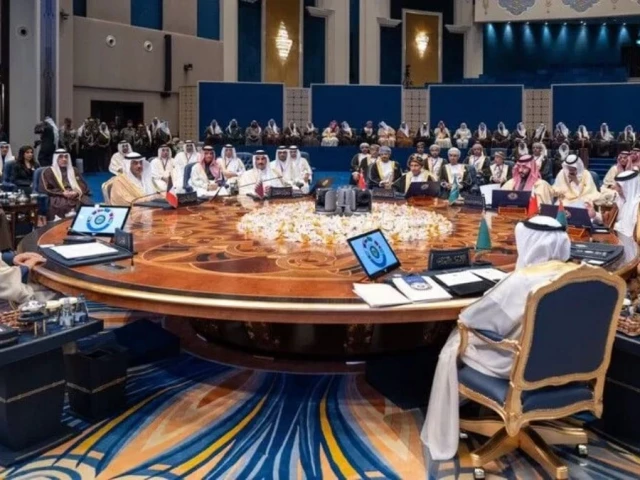
“Gulf Cooperation Council (GCC) member states have approved establishing an advanced headquarters for their unified military command in Kuwait and deploying "appropriate" forces there, the bloc's secre…”
No further details on the command or the forces to be deployed were immediately available.
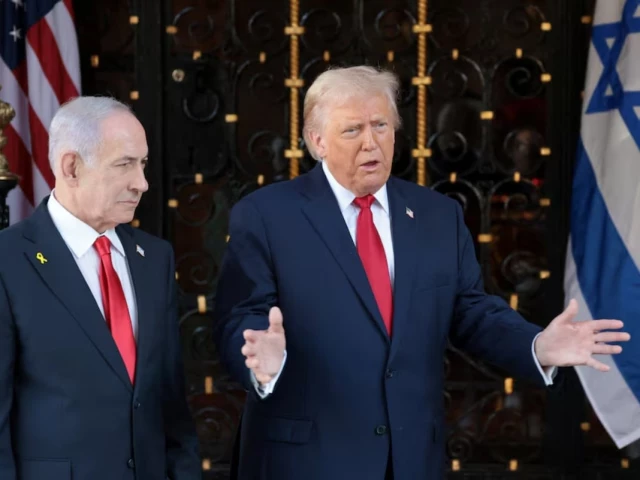
Qatar, Saudi Arabia, UAE, Kuwait, others prefer naval blockade of Iran, claims TrumpUS President Donald Trump claimed on Monday that "Qatar, Saudi Arabia, UAE, Bahrain, Kuwait, and others" prefer the continuation of the US naval blockade of Iran, during talks with Qatar's Prime Minister Sheikh Mohammed bin Abdulrahman bin Jassim Al-Thani.
Trump said he planned to hold off on new military strikes against Iran for the time being after appeals from regional countries.https://truthsocial.com/@real. Donald.
"Stay connected with Aman-e-Pakistan for ongoing live reporting and verified investigative updates."
Trump/117588608183719347"Most importantly, Qatar, Saudi Arabia, UAE, Bahrain, Kuwait, and others, would prefer the status quo, in other words, a continuation of the Greatest Naval Blockade in History, and the new Operation Iron Gate," he wrote on his social media network Truth Social.
He also reiterated that Iran cannot be allowed to get a nuclear weapon, a claim that Iran has repeatedly denied. "Therefore, Land and Sea. All have agreed that Iran cannot have a Nuclear Weapon — That is non-negotiable!
""The United States of America is fully locked and loaded with the best equipment ever made, and we don't think there's going to be any reason to use it," Trump told. Reutersreporters in an interview and a later appearance in the White House press briefing room.
He said he was acting "at the behest of countries that are their neighbours" and specifically cited Qatar, Saudi Arabia, the United Arab Emirates, Bahrain, Kuwait and others that prefer the US not to launch new attacks.
Trump spoke after meeting with Qatari Prime Minister Sheikh Mohammed bin Abdulrahman Al-Thani, a key intermediary with Tehran, as efforts to end the war ramp up following last week's US midterm election.
More than eight months into the conflict he launched alongside Israel on February 28, Trump has played down the likelihood of major warfare restarting soon but remains unwilling to accept an existing Iranian truce plan. Senior US and Gulf officials have cast doubt on the chances of an imminent deal.
Mutual attacks continue, with the US striking Iran's Qeshm island overnight,, and Iran attacking tankers in the Gulf and Strait of Hormuz this month while its Yemeni Houthi allies have hit Saudi Arabia. Diplomatic moves.
Al-Thani, who is both prime minister and foreign minister of Qatar, met Trump after visiting Tehran last week. The prime minister called his talks with both Trump and Vice President JD Vance positive.
"Grateful for the positive discussions on reaching a deal and bringing peace to the region," he said on X.Iranian security council chief Mohsen Rezaei said on X that the US should "stop manufacturing fake news about imaginary talks" and that it was "time to surrender to the seven conditions Iran has repeatedly set out.
"Iran's proposal to end the war involves an end to the US blockade of its ports, the lifting of some sanctions and a halt to bombing in return for Tehran stopping its own blockade of the Strait of Hormuz, with talks on its nuclear programme and other sanctions to follow.
The US has repeatedly rejected that plan, with Secretary of State Marco Rubio describing Tehran's conditions on Sunday as "outrageous and ridiculous and really not realistic. "Read:Iran rules out US negotiations until 7 conditions met.
Iran's Foreign Ministry spokesperson Esmaeil Baghaei defended the plan on Monday as the most reasonable offer on the table. Senior US Republicans, including Vice President JD Vance, have blamed their party's losses in last week's elections on the Iran war.
Despite the growing domestic political pressure to end the conflict, Rubio said he did not believe a diplomatic breakthrough was imminent. A senior United Arab Emirates official, Anwar Gargash, echoed that view on Monday, saying a comprehensive political settlement between the US and Iran appeared difficult.
"We should... prepare for a long period of uncertainty in which neither a decisive resolution nor stable regional order can be taken for granted," he said.
Vance, who led the negotiations for a short-lived truce in June, will also meet Al-Thani, whose country has been a prime mediator since early in the war, conveying messages between the sides and proposing ways to bridge their differences.
Anxiety over the war has pervaded the region for months, and Turkish President Tayyip Erdogan said on Monday he had not want to see a new escalation. "We emphasise at every opportunity that it is possible to resolve these issues through dialogue and diplomacy.
Unfortunately, we see a negative shift once again. We are doing our utmost to prevent this," Erdogan . Military action.
Sunday night's strikes on Qeshm island did not impact vital infrastructure or services, a provincial official 's semi-official. Farsnews agency on Monday. The US has not commented on the Iranian media reports.
A senior Iranian source told. Reutersthat US strikes were targeting Iranian radar systems serving both air defence and ship navigation, as well as bases for missile launchers and mine-laying systems.
Attacks on tankers in the Gulf and Strait of Hormuz ramped up sharply in October and have continued at the highest rate since the start of the war, figures from international maritime agencies showed last week.
Iran, which typically does not acknowledge striking vessels that report being hit by projectiles, said on Sunday a tanker had hit a mine east of the Strait of Hormuz. A state television reporter said on Monday that 11 tankers had been "disabled" over the past 10 days.
No meeting planned between Iran’s security chief and the US vice president.
Iranian Foreign Minister Abbas Araghchi on Tuesday dismissed media reports about a possible meeting between Iran’s top security official and the US vice president, describing them as baseless, according toIRNA.Exclusive | FM@araghchisays no meeting planned between Iran’s security chief and the US vice presidenthttps://t.co/yVF1YoxF7Hpic.twitter.com/eEEYxNCWOU— IRNA News Agency ☫ (@Irna.
English)November 10, 2026“These speculations and media reports are entirely baseless, and there is no plan for such a meeting,” the Iranian foreign minister.
Media reports on Monday claimed that US Vice President JD Vance and Secretary of Iran’s Supreme National Security Council Mohsen Rezaei would meet in Doha, Qatar, as part of diplomatic efforts to end the war launched by the United States and Israel against Iran on February 28.
According toIRNA, Araghchi said US President Donald Trump should have realised earlier that he had achieved none of his objectives by waging war against Iran and that he would not achieve them either.
It will not be long before Trump also realises that the path of sanctions and economic pressure was wrong, Araghchi said, according toIRNA.“The war on Iran will end neither through military action nor through increased sanctions.
The only way forward is to use the language of respect and diplomacy, while meeting Iran’s demands and the conditions set out in the two-day proposal that remains on the table,” he added. Time to surrender to Tehran's seven conditions: Iranian security chief.
Iranian Supreme National Security Council Secretary Major General Mohsen Rezaei on Tuesday it is time to surrender to Tehran’s seven conditions and stop manufacturing fake news about imaginary talks,. The war on Iran has already wrecked the US government.
But Washington flails like a desperate gambler. FOLD YOUR HAND. STOP manufacturing FAKE NEWS about imaginary talks.
Stop denying the West Asian NEW ORDER. Time to SURRENDER to the seven conditions Iran has repeatedly set out.— محسن رضایی (@ir_rezaee)November 9, 2026In a statement posted on social media on Monday, Rezaei said that the war Washington launched against the Islamic Republic has already "wrecked the US government", yet the White House continues to "flail like a desperate gambler".
The Iranian official stated that the time had come for Washington to "stop manufacturing fake news" about "imaginary talks", cease denying the emergence of a "new order" in West Asia, and "surrender to the seven conditions Iran has repeatedly set out" for ending the war and reopening the Strait of Hormuz.
Continue Reading: More in International
Swipe or click arrows to explore International desk coverage