PPP pushes through mayor-administrator amendment
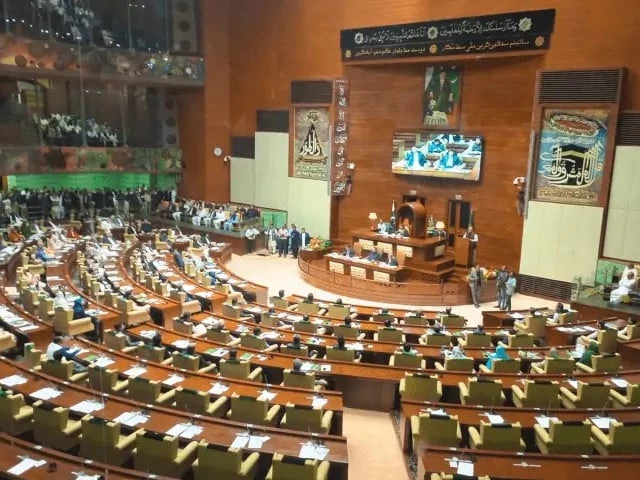
“A proposed amendment to Sindh’s local government law has emerged as the sole point of disagreement between the government and opposition parties, with the Pakistan People’s Party (PPP) insisting on re…”
The provision was among several amendments proposed by the PPP to the Sindh Local Government Act. However, all opposition parties represented in the Sindh Assembly, including the Muttahida Qaumi Movement (MQM), Jamaat-e-Islami (JI) and Pakistan Tehreek-e-Insaf (PTI), opposed it.
Members of all parties were part of a special committee constituted to examine the proposed amendments. The committee reviewed the changes clause by clause, with the government and opposition showing flexibility on most provisions. As a result, several additional proposals were also incorporated into the bill.
However, neither side was willing to compromise on the provision allowing existing mayors and chairmen to continue as administrators until new elections. The PPP subsequently used its numerical majority in the Sindh Assembly to get the amendments passed, including the contentious provision.
"Stay connected with Aman-e-Pakistan for ongoing live reporting and verified investigative updates."
Opposition representatives said they opposed the amendment on principle, arguing that neutral administrators should be appointed between the expiry of local governments’ terms and fresh elections. Speaking to The. Express Tribune, MQM Deputy Parliamentary Leader in the Sindh Assembly Taha Ahmed said the amendment would allow existing mayors and chairmen to serve as administrators until the new elections.
“These are political people. How can they be neutral?” he said, adding that the MQM would challenge the amendment in court. Read More:Mustafa Kamal says 18th Amendment created 'four countries' instead of empowering provincesJI Sindh Assembly member Muhammad Farooq also said the provision was the only point on which his party had disagreed with the government.
Farooq pointed out that JI-affiliated chairmen currently head nine towns and 87 union councils in Karachi. Despite this, he said, his party opposed the amendment because political figures should not be appointed as administrators during an interim period.
He said government officials had traditionally been appointed as administrators after local governments’ terms expired.
PPP Sindh Assembly member and Sindh government spokesperson Sukhdev Asardas Hemnani, however, defended the amendment, saying government officials had traditionally been appointed during interim periods, but political parties had repeatedly criticised the practice., opposition parties had argued that government officials could not be neutral because they worked under the provincial government.
“To avoid this criticism, the PPP introduced this amendment,” he said. Hemnani said that during the interim period, mayors and chairmen serving as administrators would only carry out essential day-to-day functions. He added that election-related powers would remain with the Election Commission of Pakistan.
He also claimed that opposition representatives had not offered an alternative and were instead seeking to delay the amendment bill. However, he maintained that the government remained open to further changes in the law. “Laws change with time.
If the opposition comes forward with good proposals, the government can introduce further amendments to the local government law,” he said. Hemnani added that the government was willing to discuss with opposition parties granting further powers to local government institutions.
The terms of the existing local government bodies are due to expire in mid-2027. Under the amended law, the Sindh government will have to inform the Election Commission of Pakistan three months before their terms expire, after which the commission will begin preparations for new elections.
The Election Commission will also have to carry out fresh delimitation of local government constituencies at least six months before the elections. The exercise could increase the number of union councils, towns and other local government units across Sindh, including Karachi.
Continue Reading: More in National
Swipe or click arrows to explore National desk coverage