Beyond the veil
“Back to Tribune. HomeT-Magazine. Beyond the veilT-Magazine. Beyond the veil. The irreversible shift in women’s political consciousness across Iran and Pakistan. ByFaiza Shah|facebooktwitterwhatsuplinkdedemailPU…”
Back to Tribune. HomeT-Magazine. Beyond the veilT-Magazine. Beyond the veil. The irreversible shift in women’s political consciousness across Iran and Pakistan. By. Faiza Shah|facebooktwitterwhatsuplinkdedemailPUBLISHED
October 11, 2026On a chilly Friday morning last month, in Tehran, the capital of the Islamic Republic of Iran presented a study in stark, jarring dualities.
In one quarter of the city, the government staged a massive military show of force, deploying paramilitary troops, anti-aircraft weapons, and strict state rhetoric to demonstrate total ideological conformity. Just streets away, a completely unscripted gathering unfolded: thousands of women and male allies took to the streets for a marathon.
"Stay connected with Aman-e-Pakistan for ongoing live reporting and verified investigative updates."
What stood out wasn't just the endurance of the runners, but how defiantly the runners flouted the dress code for women in Iran. Dozens of women ran openly without headscarves, their hair flowing freely in the breeze; others wore their veils casually draped over their shoulders.
Nobody donned the hijab. Four years after the groundswell of the“Jin, Jiyan, Azadî”(“Woman, Life, Freedom”) movement—ignited by the tragic death of 22-year-old Kurdish woman Jina Mahsa Amini in the custody of the morality police—the Iranian public sphere has undergone an irreversible change.
Even amidst heightened geopolitics, military threats, and an unrelenting domestic crackdown marked by widespread detentions and executions, the subversion of state-mandated modesty has become daily practice. Strikingly, this transformation has bled into the state’s own backyard; recent pro-government rallies have seen female attendees openly defying strict hijab regulations without state interference.
Caught between strict official policy and a shifting public, some within the Iranian establishment have begun arguing that women who back the government should still be welcomed as loyal supporters of the system—even if they don't fully comply with mandatory hijab rules. Across the border, however, a strikingly inverse battle over the female body is being waged in Pakistan.
There is no mandatory hijab enforcement by the state in Pakistan, yet religious groups and state actors police women's physical presence and voices just as strictly.
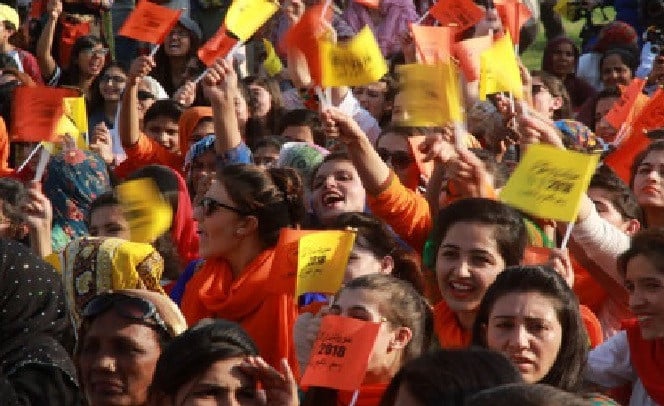
Every year on March 8, International Women’s Day, major urban centres like Karachi, Lahore, and Islamabad become flashpoints for the Aurat March, a grassroots feminist collective demanding basic civil rights, an end to gender-based violence, economic equity, and bodily self-determination.
Yet, almost synchronously, Pakistan’s religious right mobilises counter-demonstrations known as "Haya Marches" or "Hijab Marches", framing feminist demands as a Western-backed threat to traditional Islamic family values. These two scenes—Iranian women running bareheaded through Tehran and Pakistani marchers clashing over slogans in Islamabad—expose a shared reality: the female body remains the primary battlefield for political control and religious authority.
Nowhere is this struggle more visible than in the fight over who gets to occupy public space. The battleground of public space. Patriarchal authority has historically treated the female body not as an individual human entity, but as a symbolic canvas for collective honour, national identity, and religious purity.
Whenever a state or religious establishment wants to project its moral authority, regulating women is always the first move. In Iran, the mandatory hijab law, enacted shortly after the 1979 Islamic Revolution, transformed the female body into an explicit symbol of anti-Western resistance and Islamic governance.
Removing the veil was seen as a direct act of treason against the state, not a simple choice of clothing or observing one’s faith. In September 2022, Mahsa Amini’s death in police custody—after being arrested for 'improper attire'—unmasked the heavy-handed force needed to maintain state-mandated modesty laws.
The chant“Jin, Jiyan, Azadî” was born in rebellion andechoed across Kurdistan, Tehran, Baluchistan, and Azerbaijan— unifying precisely because it recognised that state authoritarianism, ethnic marginalisation, and gender oppression are bound together by the same thread.
By running bareheaded in a public marathon, Iranian women are not merely engaging in physical exercise; they are performing a radical act of public space reclamation. They are asserting that their presence in the public square is inherent, unconditioned by state approval or religious surveillance.
In Pakistan, where moral policing is decentralised across feudal systems, conservative clergy, and vigilante street politics, the battle manifests differently. The Aurat March, initiated in 2018, was conceived as an inclusive space to address urgent material realities: honour killings, forced marriages, domestic violence, workplace harassment, and legal marginalisation.
Among its notable legal victories was contributing to the historic judicial ban on the archaic and dehumanising “virginity test” for female rape survivors in Punjab. Yet, despite these tangible contributions to justice, conservative and religious circles have directed their fiercest outrage not at the systemic violence inflicted upon women, but at the marchers' assertion of physical sovereignty.
Slogans such as“Mera Jism, Meri Marzi”(“My Body, My Choice”) and placards urging society to “Stop being menstrual-phobic” triggered an explosive theological backlash. A former Minister for Religious Affairs went so far as to publicly demand that the Prime Minister rename International Women's Day as "Hijab Day" to counteract what he characterised as an assault on Islamic values.
Religious parties mobilised thousands of counter-protesters, filing police complaints alleging blasphemy—a charge carrying severe penalties in Pakistan—and issuing death threats that forced many organisers to deactivate their social media accounts and go into hiding.
This exposes a clear double standard: while conservative leaders rail against Western influence, they routinely use state power and public intimidation to deny women the basic rights granted by both international law and religious tradition. Good feminism vs bad feminismdoes a placard asserting ownership over one’s physical person elicit more hostility than the rape, murder, or structural disenfranchisement of women?
The answer lies in the deep-seated societal binary of the "Good Muslim Woman" versus the "Bad Muslim Woman". In mainstream conservative discourse across South Asia and the Middle East, women are allowed to succeed, but only within strict limits —provided it remains neatly compartmentalised within acceptable patriarchal boundaries.
A woman advocating for female literacy, building girls' schools, or demanding access to maternal healthcare is often tolerated, if not praised, as a "nurturing mother" or "dutiful daughter" fulfilling her domestic and community duties. This is categorised as benign, acceptable reform.
However, the moment a woman asserts bodily autonomy—claiming total sovereignty over her physical form, her wardrobe, her reproductive choices, her mobility, and her sexuality—she crosses an invisible ideological line. She transitions from a passive subject to be protected into an autonomous agent demanding rights.
By declaring“Mera Jism, Meri Marzi,”Pakistani women explicitly reject the notion that their bodies belong to their fathers, husbands, brothers, or the state. They undermine the foundation of a system that expects women to trade their obedience for safety provided by men.
Critics write off bodily autonomy as a Western idea that threatens Islamic values. Traditionalists argue that giving women individual freedom destroys the family and disrupts social order. Because of this, counter-marches like the 'Haya March' centre on defending the family—pushing the idea that a woman's main role is to stay modest, self-sacrificing, and obedient.
Yet this argument deliberately ignores the socio-economic realities of millions of working-class Muslim women for whom modesty laws offer no protection against economic exploitation, domestic violence, or state neglect. By focusing entirely on clothing and public decorum, conservative power structures distract from their own failure to provide safety, economic justice, and basic human dignity to female citizens.
Reclaiming feminism in Islamdecades, Muslim feminist theologians have argued that the subjugation of women in Muslim-majority societies is not a result of divine revelation, but of centuries of patriarchal interpretation (fiqh) that conflated historical Arab cultural norms with eternal divine intent.
Scholars like Fatima Mernissi, Amina Wadud, and Asma Barlas have systematically demonstrated that the Qur'an introduced revolutionary protections for female autonomy in seventh-century Arabia—granting women independent legal status, rights to inheritance, property ownership, marital consent, and financial independence centuries before similar rights were recognised in the West.
Mernissi’s historical-critical analysis revealed how certain misogynistic traditions were fabricated or contextually distorted by male political elites in the later centuries to strip women of political power and push them out of the public sphere. Amina Wadud frames this as a fundamental matter of faith: in Islam, absolute authority belongs to God alone.
When a state or family claims ownership over a woman’s body—dictating what she wears or where she goes—it effectively tries to place human control on par with divine authority. Furthermore, Islamic feminist theology directly addresses the question of bodily autonomy.
Far from treating the female body as an inherently shameful source of temptation that must be veiled, hidden, and controlled, progressive Islamic jurisprudence emphasises that the body is a divine trust (amanah) given directly to the individual. Progressive Islamic thinkers also argue that faith cannot be forced.
In this view, a person's body is a trust given directly to them by God, and genuine spirituality requires personal choice. When the state or society coerces a woman to cover herself, pray, or obey male authority, those actions lose their spiritual meaning—because under Islamic principle, faith relies entirely on free will.
When Pakistani feminists demand an end to domestic violence, marital rape, and honour killings, they are building on a legacy that stretches back to the 1980s. During General Zia-ul-Haq’s military dictatorship, groups like the Women’s Action Forum took to the streets to protest state-enforced laws that institutionalised female inequality.
Today’s activists—whether marching in Pakistan or running unveiled in Iran—are not rebelling against faith, but against man-made systems of control designed to strip them of basic safety. Decolonising liberationcritical challenge in addressing women’s rights in the Muslim world is the trap of dual orientalism.
On one side stands Western imperialist discourse, which frequently weaponises the idea of 'rescuing Muslim women' to rationalise military action, reducing complex societies to a simple story of backwardness. On the other side stand domestic religious hardliners who exploit this history, framing any internal call for women's liberation as a treasonous submission to Western culture.
Muslim women are thus caught in a double bind: condemned by Western saviours if they choose to embrace religious practice or attire, and persecuted by indigenous patriarchs if they demand bodily autonomy and civil rights. The Iranian women running in the Tehran marathon and the Pakistani women marching in the streets of Karachi are actively dismantling this false binary.
They refuse to allow foreign powers to define their liberation, just as they refuse to allow local clerics to use religion against their fundamental rights. Their struggle demonstrates that bodily autonomy is not a foreign ideology—it is an innate human necessity.
Suppressing women under the guise of religious purity is a distinctly modern panic, standing in stark contrast to a history where Muslim women actively shaped public and intellectual life. Today’s regimes are not defending tradition; they are trying to enforce a control that even past centuries didn't demand.
But while state violence can police behaviour, it cannot erase political consciousness. The old boundaries have collapsed, and no state decree can force women to un-see the rights they have already claimed.
By rooting their struggle for bodily self-determination within broader frameworks of human dignity, social justice, and authentic theological reform, Muslim women are demonstrating that faith and freedom are not mutually exclusive.
The future of gender justice in the region will not be dictated by state decrees or religious fatwas, but by the quiet, unrelenting courage of women reclaiming their bodies, their spaces, and their sacred right to live free. Pages.
Pakistan. Business. World.
Opinion. Life & Style. Sports.
Blogs. Videos. Our Sites.
Express News. Urdu E-Paper. English E-Paper.
Sindhi E-Paper. Cricket Pakistan. Express Live.
Campus Guru. Express Entertainment. Food Tribune.
About Us. Contact Us. Online Advertising.
Privacy Policy. Copyright. Fuel Prices Pakistan.
Gold Prices Pakistan. Prayer Timing Pakistan. Weather Forecast Pakistanfollow us
Continue Reading: More in National
Swipe or click arrows to explore National desk coverage
 National
Shane Gillis swears on live 'SNL' Dr. Seuss-inspired sketch, apologises for slip-up
 National