When poetry lived in landhi
“Back to Tribune. HomeT-Magazine. When poetry lived in landhiT-Magazine. Next Story. When poetry lived in landhi. Beyond the posh drawing rooms and grand halls, Karachi’s poetry once thrived in its working-class…”
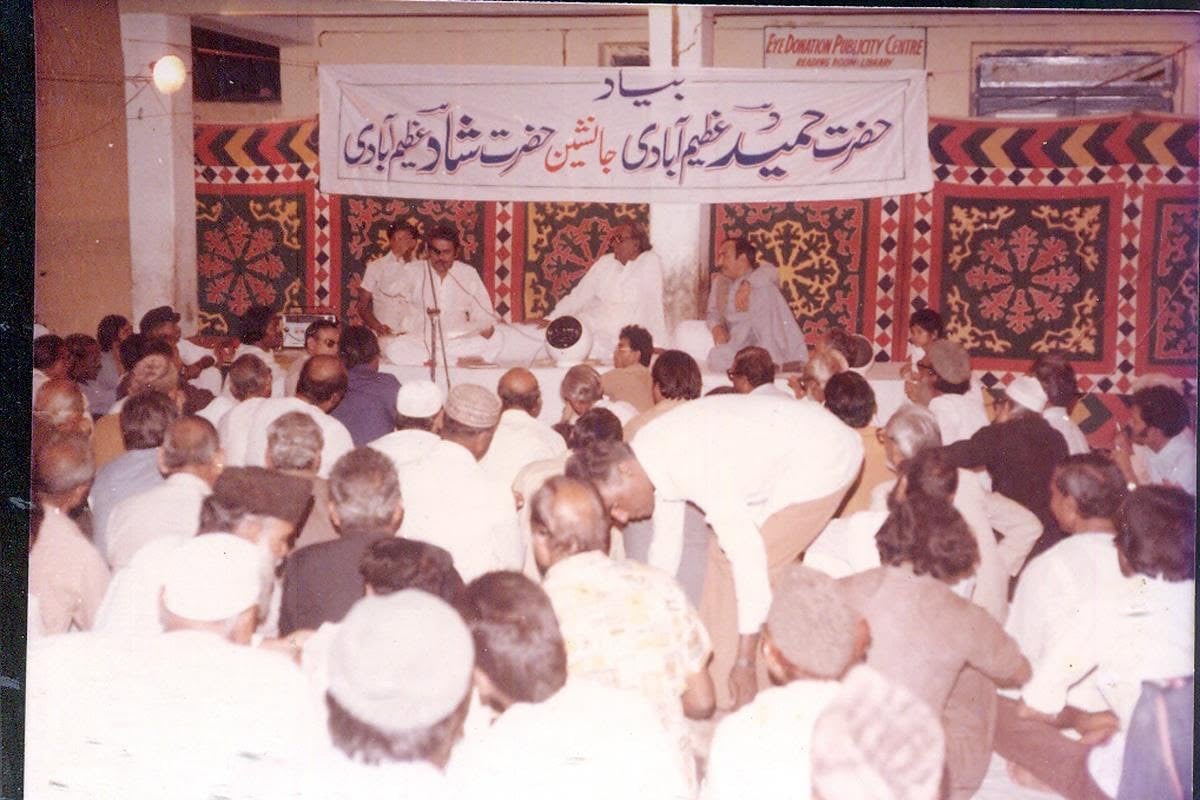
Back to Tribune. HomeT-Magazine. When poetry lived in landhiT-Magazine. Next Story. When poetry lived in landhi. Beyond the posh drawing rooms and grand halls, Karachi’s poetry once thrived in its working-class neighborhood. By. Our Correpondent|A photograph from one of the Bazm-e-Hameed mushairasfacebooktwitterwhatsuplinkdedemailPUBLISHED
October 11, 2026Although much has been written about the decline of the mushaira in Karachi, not much attention has been paid to the working-class neighbourhoods that served as literary powerhouses of the metropolis—and to the lesser-known literary organisations that kept poetry alive there until the very end.
When we lament Karachi's rapid literary or perhaps intellectual decline, especially from the late 1980s onwards, we often speak in generalities and fall prey to familiar phrases such as "the mushaira lost its audience," "the poets grew old," "the city changed," and the like.
"Stay connected with Aman-e-Pakistan for ongoing live reporting and verified investigative updates."
However, this broad narrative obscures a more textured story that played out in the city's relatively lower-income neighbourhoods, far from the affluent drawing rooms of Gulshan-e-Iqbal, Defence, and Clifton. Headquartered on the Eastern edge of the city, in Landhi's C-1 area, a densely populated, working-class pocket, Basm-e-Hameed was one of those rare literary organisations that emerged in the 1960s.
It did the quiet, unglamorous work of sustaining mushaira culture in a part of the city otherwise known for its acute poverty and socioeconomic deprivation. Khalid Alig, Himayat Ali Shair, Hassan Hameedi, Zahida Hina, Mubarak Suroor, and other renowned poets at a mushairaA legacy rooted in poetry.
The organisation was named after Hameed Azeemabadi, a well-known Urdu poet, literary figure, and—perhaps unexpectedly—a prominent footballer from Azeemabad, present-day Patna, the capital of Bihar, India.
A shagird (student) of Shaad Azeemabadi, a leading pre-Partition Urdu poet from Bihar, Hameed authored several acclaimed poetry collections, including Sarosh-e-Maikada, Meezane-e-Sukhan, Rasikh, and Maikhana-e-Ilham, also known as Deewan-e-Shaad — the last being a poetic compilation of Shaad Azeemabadi's works.
Although Hameed Azeemabadi never migrated to Pakistan himself, his elder sons—Hasan Hameedi, Aziz Hameedi, and Sagheer Hameedi—co-founded Bazm-e-Hameed in the early 1960s. The organisation was dedicated to promoting lesser-known poets and writers from Landhi and Korangi areas, primarily through the mushaira platform — a longstanding tradition of Urdu literary culture in the Indian subcontinent.
A poet recites his ghazal. Among the co-founders, Hasan Hameedi was the best-known literary figure. A resident of Purana (Old) Sukkur, where he lived in the historic Jinnat Building, near Jinnat Chowk, Hasan was also a prominent political activist with pronounced leftist leanings.
He authored several poetry collections, including Masnawi Jurm-e-Aagahi and Sahar Aawaz Deti Hai. Aziz Hameedi and Sagheer Hameedi were both prominent educationists and Urdu poets. The tarhi mushaira tradition.
What set this literary organisation apart was its long-standing tradition of hosting the tarhi mushaira, in which poets were required to recite a new ghazal based on a misra-e-tarah—a specific prescribed line. This format demanded both technical mastery and creative improvisation, and it attracted some of the era's finest poets.
Among those who regularly featured in these mushairas were Johar Saeedi, Khalid Alig, Hasan Musanna Nadwi, Saleem Kausar, Kaif Banarasi, Rasa Chughtai, Pirzada Ashique Keranvi, Zahida Hina, Zafar Zaidi, Naqqash Kazmi, Shahid Alvi, Akhtar Saeedi, Rasheed Asar, Aleem Mahshar, Zaigham Hameedi, Ziaul-Hasan Zia, Rashid Hasan Khan, Professor Shadab Ehsani, Dr Aziza Anjum, Mubarak Hussain Saroor, Naeema Sahar, and Syed Muhammad Sohail, among many others.
Aziz Hameedi. Poetry in the margins. Although many literary organisations were active in Karachi during the 1960s and 1970s with a similar mission, this particular one stood apart because of its location and the limited resources at its disposal.
Most of the poets from the area came from humble backgrounds and worked menial jobs to earn a living. I have witnessed many such poets arriving on foot in the dead of night from far-flung parts of the city simply to recite their ghazals and poems, without the hope of or receiving any honorarium whatsoever.
Mostly held at the community centre adjacent to the Landhi Fire Brigade Station, these literary gatherings began late at night and continued until dawn. For the organisers, working with limited resources, it was a herculean task to accommodate the large number of attendees, and provide them with a decent meal or refreshments.
These usually consisted of little more than chai (tea), biscuits, and boiled eggs. Residents living near the mushaira venue also helped provide accommodation for those arriving from distant parts of the city. This included collecting large numbers of rugs, sheets, pillows, bolsters, and blankets from neighbouring households to accommodate the guests for the night.
It was a communal effort in the truest sense — poetry sustained not by institutions or grants, but by neighbours sharing what little they had. Most importantly, despite the conservative social milieu, women's participation was equally encouraged at these events, with special arrangements made for those observing purdah.
In this, the organisation was ahead of its time, creating a space where literary merit mattered more than social convention. Naeema Sahar, 81, is one of the living poets who regularly attended the mushairas hosted by Bazm-e-Hameed.
Recalling those gatherings, she says: “The mushairas were always held on the last Thursday night of every month, an occasion we eagerly awaited and looked forward to attending. What made these gatherings particularly special was that they were organised by four brothers in memory of their late father, Hameed Azeemabadi.
With the Hameedi brothers passing away one by one, exclusive mushairas were held in memory of each brother. Following the death of the last scion, Sagheer Hameedi, the organisation itself became a part of history, bringing this remarkable literary tradition to an unfortunate end.
There is no doubt that the people behind it, despite limited resources at their disposal, gave generously of their time and energy to keep the literary flame alive.”The decisive blow.
Bazm-e-Hameed, like many other literary and cultural organisations in Karachi, did its best to keep the literary flame burning in an area otherwise known for its socioeconomic deprivation and widespread poverty.
However, the onset of the 1990s, marked by deteriorating law and order and the rise of armed political groups that held the entire city to ransom for the next three decades, dealt a decisive blow to it, eventually extinguishing its presence from Karachi's literary scene.
The organisation that had once drawn poets on foot from across the city could no longer guarantee their safety. The mushairas that had lasted until dawn fell silent. And with them, a particular kind of Karachi—plural, curious, and deeply literary—faded a little further into memory.
"More than a literary gathering, it was an institution in its own right that, under the patronage of senior poets, nurtured young talent and taught aspiring poets the art and craft of Urdu poetry,” says Dr Pirzada Sharf-e-Alam, Urdu scholar and author of Urdu Ishtihariyat Ki Tareekh and Pichka Hua Aadmi.
“Over time, however, the Bazm evolved into a family tradition and a means of nurturing and cultivating a deep love for literature across generations.”Naeema SaharA memorable literary legacy.
The bittersweet story of the rise and decline of Bazm-e-Hameed is a necessary reminder that literary culture does not have to be confined to the elite enclaves of Karachi, or to a certain socio-economic class. It flourished in community centres and cramped cottages in suburban areas where lower-income classes resided.
Literary culture here was nurtured by those who inherited it from their Indian ancestors and sustained by poor creators who worked menial jobs by day, composed ghazals in the evenings, and recited them in the dead of night.
As a new crop of Karachi's literati continues to find its footing amid the host of challenges facing the city, it is worth remembering that the city's cultural heritage is not confined to its so-called literary festivals and intellectual funfairs in the city's posh areas.
Its true essence also resides in the cherished memories of literary organisations such as Bazm-e-Hameed, and in the ghazals that were recited until dawn, when the chai ran out, and the blankets were returned to their owners. Naeema Sahar with Mubarak Suroor.
Talking about how the organisation represents a rich literary tradition and a remarkable yet largely unrecognised chapter in the literary scene of yore, another Urdu poet, Saiyad Naiyarul Hasan, shared that, “Every year, it brought together poets, both renowned and obscure, and provided them with an opportunity to meet, exchange ideas, and benefit from one another's poetic creations.
Although owing to the unfortunate vicissitudes of time, many of these poets remained largely unknown throughout their literary careers, their poetry was nevertheless distinguished by a unique taste and flavour. It was a source of immense pleasure, filled with words that spoke of possibilities and hope—qualities that may not even be found in the poetry of many celebrated poets.
"However, the late Urdu poet Pirzada Ashique Keranvi once remarked, “Thanks to those tarhi mushairas of the bazm, countless poets went on to become published poets with diwans of their own.”Perhaps that is what makes this a story worth remembering.
Its legacy was not built on grand halls or generous grants, but on the quiet persistence of people who believed that poetry mattered. In a city whose literary history is often and better-known institutions, Bazm-e-Hameed offers another story — of ordinary people, and of ghazals that continued until dawn.
Perhaps there is something to be learned from those long nights too. In an age of screens and solitary scrolling, there is still value in putting the phone away, sitting together and listening — to poetry, to stories, and to one another.
The writer is a communications specialist and can be reached atfaizanusmani76@gmail.com. All facts and information are the sole responsibility of the writer. Pages.
Pakistan. Business. World.
Opinion. Life & Style. Sports.
Blogs. Videos. Our Sites.
Express News. Urdu E-Paper. English E-Paper.
Sindhi E-Paper. Cricket Pakistan. Express Live.
Campus Guru. Express Entertainment. Food Tribune.
About Us. Contact Us. Online Advertising.
Privacy Policy. Copyright. Fuel Prices Pakistan.
Gold Prices Pakistan. Prayer Timing Pakistan. Weather Forecast Pakistanfollow us
Written by Sheheryar Munawar
Aman-e-Pakistan Senior Journalist & Bureau Reporter
Continue Reading: More in National
Swipe or click arrows to explore National desk coverage
 National
Shane Gillis swears on live 'SNL' Dr. Seuss-inspired sketch, apologises for slip-up
 National