Oil, ME tensions drive PSX down
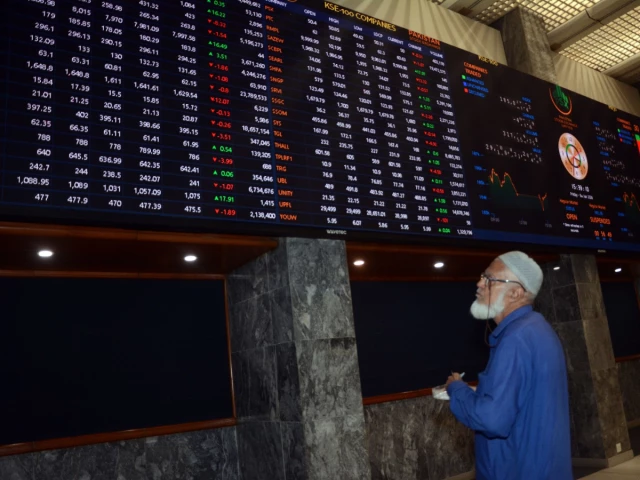
“Renewed geopolitical instability across the Middle East and escalating global crude oil prices dragged the Pakistan Stock Exchange (PSX) into negative territory this week, with the benchmark KSE-100 I…”
On a day-to-day basis, the KSE-100 Index extended its decline on Monday, closing at 173,636, down 1,693 points (-0.97%), after trading between an intraday high of 175,353 and a low of 173,603. The market fell on Tuesday as much as 2,145 points intraday before recovering some of its losses to close at 172,642, down 993 points (-0.57%).
PSX witnessed a negative session on Wednesday, with the KSE-100 Index declining 699 points (-0.40% day-on-day, or DoD) to close at the 171,944 level. PSX witnessed a negative session again on Thursday, with the KSE-100 Index declining 3,079 points (-1.79% DoD) to close at 168,865.
On Friday, the market initially stumbled as Houthi strikes on Saudi energy sites drove up oil prices and dampened investor mood. Sentiment rebounded later when reports of talks between Gulf nations and Iran eased crude prices, driving a recovery that lifted the index 0.98% to close at 170,512.
"Stay connected with Aman-e-Pakistan for ongoing live reporting and verified investigative updates."
Arif Habib Limited (AHL) noted that the KSE-100 came under pressure this week amid renewed US-Iran tensions and higher oil prices, with the index falling from 175,329 points last week to 170,512 points, a 2.75% week-on-week (WoW) decline. Investor sentiment remained cautious as geopolitical uncertainty and concerns over higher energy prices continued to weigh on market activity.
Oil production improved 1.8% WoW to 68.4k barrels of oil per day (bopd), mainly due to higher flows from Adhi, KPD and Sharf, while gas production increased 2.0% WoW to 3,088 million cubic feet per day (mmcfd), driven by higher production from Mari, Uch and revival in production from Shewa at 68 mmcfd.
AHL further explained that remittances by overseas Pakistanis increased by 17% year-on-year (YoY) to $3.7 billion during August 2026 compared to $3.1 billion during August 2025. On a month-on-month (MoM) basis, remittances increased by 1%.
In the first two months of fiscal year 2027 (2MFY27), remittances increased by 15% YoY to $7.3 billion. Fiscal year 2026 (FY26) cement sector profits rose 13% YoY to Rs138 billion, supported by 7% higher dispatches to 50.5 million tonnes, higher utilisation of ~60%, and a 33% decline in finance costs.
The International Monetary Fund (IMF) is expected to visit Pakistan on September 23, 2026 to review progress under the $7 billion Extended Fund Facility (EFF) and $1.4 billion Resilience and Sustainability Facility (RSF) programmes. The mission is likely to stay until early October and conduct the fourth EFF and third RSF reviews for the year ended June 2026.
Total liquid foreign exchange (FX) reserves increased 5.3% WoW to $23.7 billion, with State Bank of Pakistan (SBP) reserves up 7.0% to $18.3 billion, while banks' reserves remained broadly stable at $5.4 billion; import cover improved to 2.74 months from 2.56 months,.
Naya Nazimabad Apartments Real Estate Investment Trust (REIT) saw strong demand, with the book building oversubscribed eight times and the public offering 4.3 times oversubscribed. The REIT raised Rs1.01 billion against the total demand of Rs5.6 billion.
Petroleum prices rose under the new daily pricing mechanism: Motor Spirit (MS) up Rs21.8/litre to Rs370.8/litre, High Speed Diesel (HSD) up Rs23.72/litre to Rs398.4/litre, tracking the seven-day average of Platts prices; Petroleum Levy (PL), Inland Freight Equalisation Margin (IFEM) and Oil Marketing Company (OMC) margins remain unchanged, said AHL.Syed Danyal Hussain of JS Global noted that the KSE-100 remained negative throughout the week, falling by 4,817 points WoW, as renewed geopolitical tensions between Iran and the US continued to weigh on investor sentiment.
Meanwhile, fighting intensified between the Iran-backed Houthis and Saudi Arabia, with the group making significant advances around the Bab-el-Mandeb Strait, raising concerns over regional stability and global trade disruptions and pushing Brent crude back above $100/bbl. Meanwhile, domestically, fuel prices continued to climb, with petrol rising by Rs25/litre WoW to Rs370.8/litre while HSD prices rose by Rs20/litre to Rs398.04/litre.
Remittances during August 2026 increased by 17% YoY to $3.65 billion with the cumulative remittances for 2MFY27 recorded at $7.2 billion (up 15% YoY). The government has decided to reduce refinery crack margin for HSD to $30/bbl from $41/bbl during wartime conditions.
Meanwhile, the IMF's fourth review is expected to start next week. The draft Auto Policy 2026-31 has been finalised following stringent review by government committees with a heavy focus on electric vehicle (EV) adoption. However, IMF consultation, expected in October, and subsequent Cabinet approval remain pending.
Continue Reading: More in International
Swipe or click arrows to explore International desk coverage
 International
President Zardari paid all expenses for private foreign trip, says spokesperson
 International