'End march, sit-ins and we will talk': PM Shehbaz once again extends olive branch to PTI
“Prime Minister Shehbaz Sharif on Tuesday renewed an offer of talks to Pakistan Tehreek-e-Insaf (PTI), saying the government was prepared to engage with the opposition if the party ended its long march…”
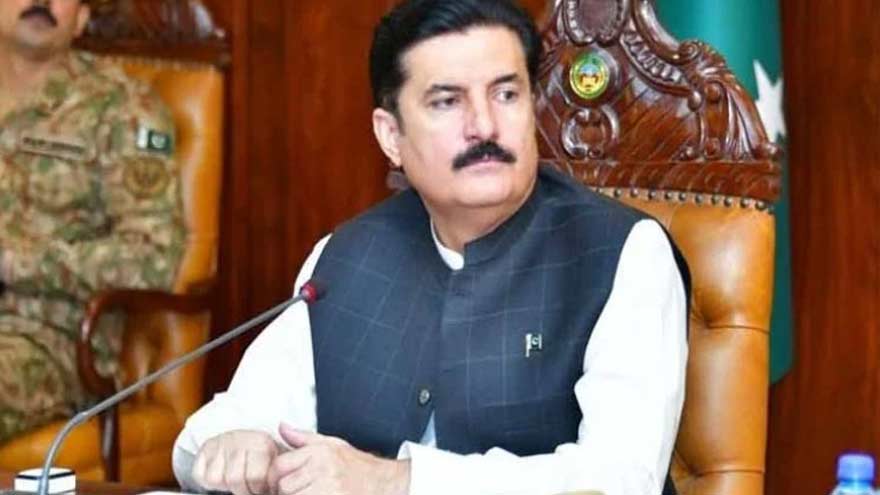
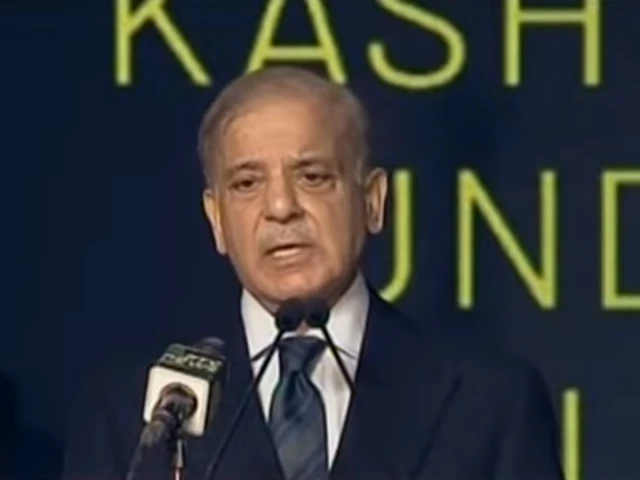
“End your long march. If you end it, then we will certainly sit with you and talk. So that Pakistan moves forward with mutual courage, hard work, trust and meditation," PM Shehbaz said at the groundbreaking ceremony for the Kashmir Chowk Underpass in Islamabad.
The prime minister said the government had decided to engage in dialogue after consultation and had held two days of talks between its representatives and the opposition in the chamber of National Assembly Speaker Ayaz Sadiq. “There was a lot of discussion, and there was every hope that, God willing, these talks would reach their desired conclusion,” he said.
“But unfortunately, that did not happen.”The prime minister said that at the last moment, "they not only demanded changes to something that had already been prepared, but their only objective was that these talks should somehow not succeed. "“There is no doubt that the first target of this sit-in and long-march politics will be your economy.
"Stay connected with Aman-e-Pakistan for ongoing live reporting and verified investigative updates."
If your worker or engineer does not reach the factory, manufacturing site or office on time, whose loss is it? It is the loss of the nation and the country,” he said. PM Shehbaz said the government had spent around a year and a half working to stabilise the economy.
“Pakistan’s economy has been brought back on its feet through collective efforts and teamwork over the last one and a half years. We have achieved macroeconomic stability, and now the time has come for growth and development,” he said.
He pointed to increases in September exports, IT exports, remittances and domestic production. “Today, Pakistan’s standing at the international level has improved, and even our adversaries are being forced to acknowledge it,” the prime minister said.
“Do you want to damage this? Do you want to harm Pakistan’s progress?”The prime minister said the government would "not allow this to happen. " He said thatt.
The law will take its course, and protecting the lives and property of the people is our responsibility. “Even now, I would say: come to your senses. End your long march and end your sit-ins,” he said.
“We will sit with you and talk so that Pakistan can move forward through mutual cooperation, hard work, honesty and integrity.”He said this was the aim of the government and “the voice of every Pakistani”.
The prime minister, earlier in his speech, praised Interior Minister Mohsin Naqvi and his team for planning to complete the Kashmir Chowk Underpass within a month. Referring to the name of the project, PM Shehbaz expressed hope that the road would eventually extend towards Kashmir and Srinagar.
“God willing, this road will one day reach Kashmir, reach Srinagar, and freedom and rights will be achieved,” he said. He said the construction of roads, flyovers and underpasses helped children, students, cyclists, rickshaw drivers, workers and other citizens reach schools, universities, offices, factories and commercial areas on time.
“They work day and night and take the country’s economic and social development forward,” he said. “This entire process, praise be to God, is continuing through collective efforts,” he added. Earlier, Naqvi said the Kashmir Chowk Underpass was part of preparations to transform Islamabad ahead of the Shanghai Cooperation Organisation (SCO) conference.
“The prime minister’s vision was that before the SCO conference, Islamabad had to be made a different Islamabad,” Naqvi said, noting that less than a year remained before the conference.
“For the conference, the prime minister is doing his meetings, but for us the most important thing is the beautification of Islamabad and the facilities for the delegates who will come,” he said. The underpass and the Islamabad Expressway were among the projects being undertaken as part of the plan.
“Once the underpass and the expressway are completed, the journey from Rawalpindi to Islamabad will be 16 to 18 minutes, which used to take around half an hour,” Naqvi said. He said State Minister for Interior Talal Chaudhry was personally overseeing efforts to make Islamabad plastic-free and cashless.
On the plastic-free initiative, he said legislation had already been passed. "Implementation will be difficult, but I know Talal will succeed,” he said. The target for the initiative was December 31, Naqvi said.
He added that Chaudhry was holding daily meetings on the cashless Islamabad project and that the government hoped to begin work on both initiatives before the end of the year. “We need to take the lead as the federal government so that the rest of the country can follow,” Naqvi said.
Naqvi also outlined plans to expand Islamabad’s green spaces. “We have started a project to make F-9 Park like Hyde Park,” he said. “We are also building a safari park on 450 acres, which will be the biggest safari park in Asia.”Another park roughly the size of F-9 Park was also planned, he said.
“God willing, when the prime minister took charge and when we leave, Islamabad will be three times greener,” Naqvi said. Naqvi said Islamabad had seen little development work for 20 to 25 years while its population had tripled and that is why fixing the infrastructure was "the most important thingg.
"He hoped the development undertaken during the government’s tenure would serve Islamabad for decades. The minister said the government was also working to digitise all land records in Islamabad, with December 31 set as the target.
Turning to the performance of elected representatives, Naqvi said the public would judge them by how they used their time. “The public wants to see whether their elected representatives are spending every minute for them or on negative politics,” he said.
“On one side, there is an elected representative who has not gone to the office and has not held a meeting for a month. On the other side, there is someone who does not give even an hour’s gap and continues working for the public,” he said.
“I would ask the public to think about these things: the people you elect, where are they spending their time?”
Continue Reading: More in National
Swipe or click arrows to explore National desk coverage